By KASTobias / CJJSantander
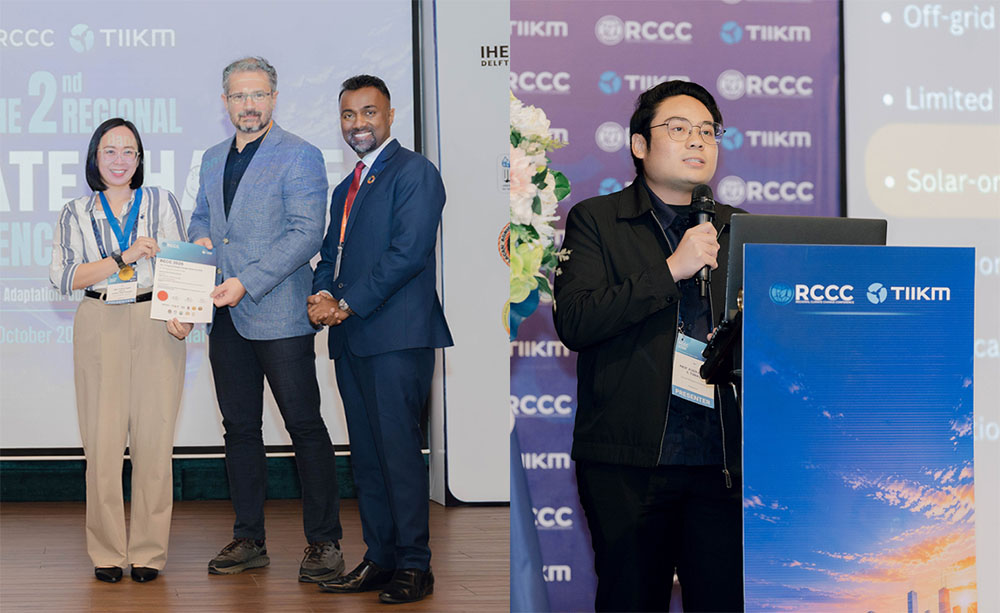
(Left) Engr. Jaspe-Santander receives her Certificate of Recognition as the Best Presenter for the session Integrated Modeling Approaches for Managing Climate-Resilient Water Systems and Hydroclimatic Extremes (Right) Engr. Tobias presents their DOST-funded wind turbine project at Concepcion Iloilo.
Two faculty members from Central Philippine University (CPU) College of Engineering presented their research at the 2nd Regional Climate Change Conference (RCCC 2026) in Bangkok, Thailand, where one received the Best Session Presentation Award. The CPU delegation also participated in a bilateral academic forum with the International Institute of Knowledge Management (TIIKM) to discuss possible research partnerships.
Held on October 15–16, 2026, at the Ambassador Hotel in Bangkok, the conference gathered researchers and professionals to discuss climate change, adaptation, and sustainability.
Engr. Kleio Alfric S. Tobias, Officer-in-Charge of the Department of Mechanical Engineering, and Engr. Christsam Joy S. Jaspe-Santander, Chairperson of the Department of Chemical Engineering, represented the University and presented their respective studies. Engr. Jaspe-Santander received the Best Session Presentation Award for her research presentation.
Engr. Jaspe-Santander presented “Scenario-Based Estimates of Future Streamflow Under Climate Change in the Jalaur River Basin, Philippines,” co-authored with Dr. Mukand S. Babel and Dr. Ian Dominic F. Tabañag. The study examined projected changes in river streamflow under different climate change scenarios and their implications for water resource management and climate adaptation.
Engr. Tobias presented “Hybrid Renewable Energy as Climate-Resilient Infrastructure for an Off-Grid Island Community in the Philippines,” co-authored with Dr. Aries Roda D. Romallosa and Engr. Caesar Rico S. Acanto. The study discussed the implementation of a hybrid wind–solar renewable energy system in Concepcion, Iloilo, and its potential to provide sustainable electricity to geographically isolated communities.
Both research abstracts underwent double-blind peer review before being accepted for oral presentation at the conference organized by TIIKM.
Apart from their research presentations, Engr. Tobias and Engr. Jaspe-Santander participated in a Bilateral Academic Forum between CPU and TIIKM on October 15, 2026. The meeting provided an opportunity for both institutions to discuss shared research interests and explore possible collaborations in climate change, sustainability, and knowledge exchange. The discussion also considered opportunities for joint research activities and future academic cooperation. While no formal partnership was announced, the meeting established initial discussions for potential institutional collaboration.
The researchers expressed their gratitude to the CPU Office of the Vice President for Research, Development, and Extension (OVPRDE), the Department of Chemical Engineering, and the Department of Mechanical Engineering for their institutional support.
The two studies addressed concerns affecting Philippine communities, including electricity access in isolated areas and the potential effects of climate change on water resources. Their presentation at RCCC 2026 brought these locally conducted studies to an international audience, while the bilateral discussion with TIIKM offered opportunities for future research cooperation. These activities demonstrate how university research can address community needs while creating opportunities for collaboration with international academic institutions.