
By Nicolle S. Curtom, RN, Master of Arts in Nursing Student
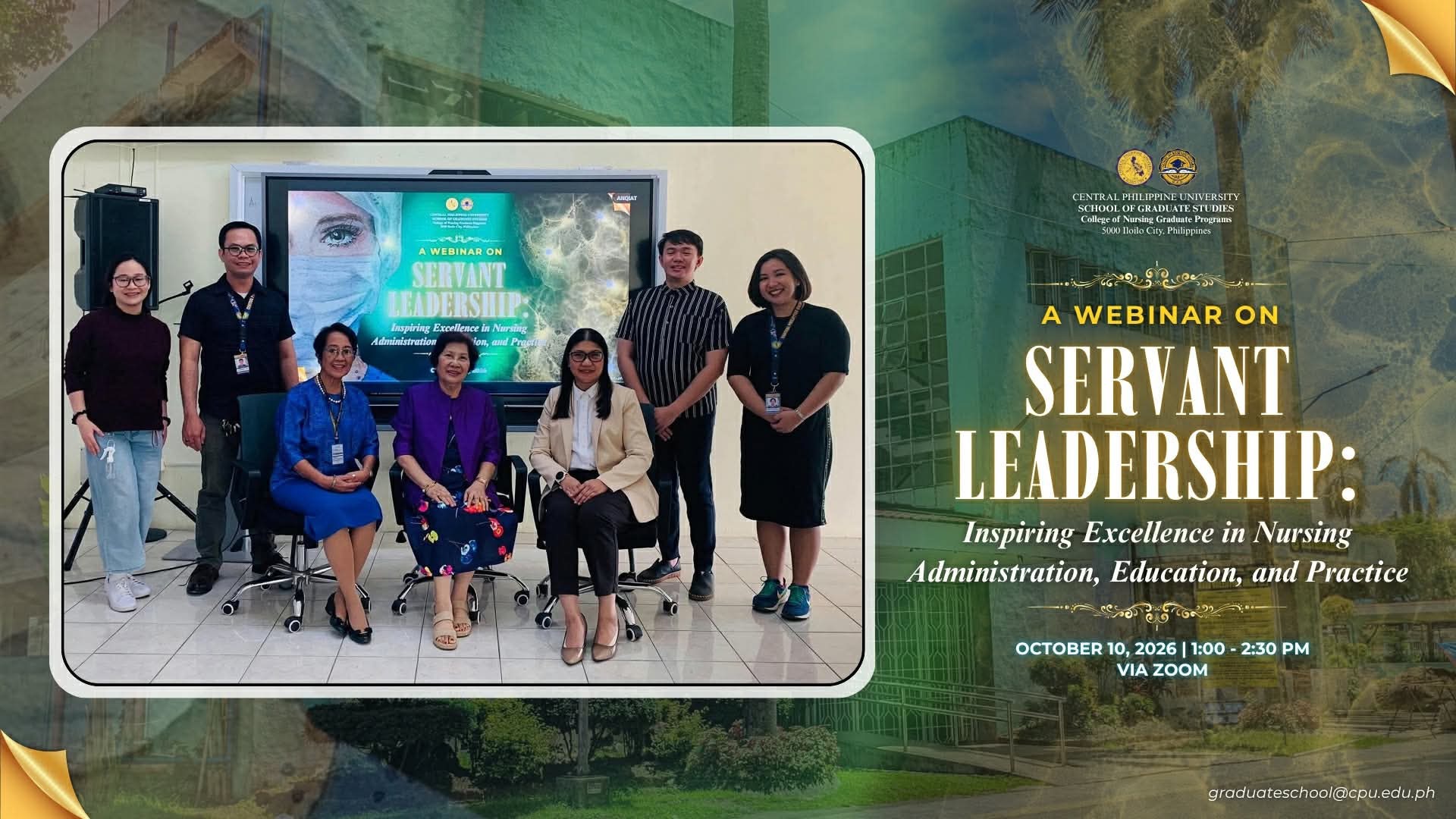
A commemorative photo of the resource speaker and organizing team following the webinar on “Servant Leadership: Inspiring Excellence in Nursing Administration, Education, and Practice,” held in celebration of the 75th anniversary of the School of Graduate Studies, Central Philippine University.
In celebration of the 75th anniversary of the School of Graduate Studies (SGS) of Central Philippine University (CPU), a webinar titled “Servant Leadership: Inspiring Excellence in Nursing Administration, Education, and Practice” was conducted via Zoom on October 14, 2026. The activity brought together graduate students, nursing professionals, educators, and administrators to explore the principles of servant leadership and their relevance to advancing excellence in the nursing profession.
The program formally commenced with the doxology, the singing of the Philippine National Anthem, and the CPU Alma Mater Song, followed by an opening prayer led by Assoc. Prof. Herme A. Borlado, MAN, Program Assistant Head. An online pre-test was administered to assess the participants’ initial understanding of servant leadership. This was followed by a welcome message from Althea U. Denuevo, DM, CPA, Dean of the School of Graduate Studies, who welcomed the participants and highlighted the importance of the activity in promoting professional development and lifelong learning as part of the institution’s milestone celebration.
The resource speaker was introduced by Sarla F. Duller, PhD, RN, MN, NP, FNYAM, Head of the Master of Arts in Nursing (MAN) Program. The webinar featured Lilia A. Delicana, DM, MAN, RN, a devoted Centralian who earned all her academic degrees from Central Philippine University, including her Bachelor of Science in Nursing (BSN), Master of Arts in Nursing (MAN), and Doctor of Management in Public Management (DMPM). Her academic journey and professional expertise made her a fitting resource person for the discussion on servant leadership in nursing.
During the presentation, Dr. Delicana discussed the principles of servant leadership and their application in nursing administration, education, and clinical practice. She emphasized that servant leadership begins with a genuine commitment to serving others. Rather than focusing solely on authority, position, or personal achievement, servant leaders prioritize the needs, growth, and well-being of the people they lead. The discussion highlighted the importance of listening, empathy, stewardship, commitment to the growth of people, and the development of a supportive and collaborative environment.
The presentation also explored the characteristics of servant leadership, including Larry Spears’ ten characteristics, which provide a framework for developing ethical, people-centered, and service-oriented leaders. The speaker discussed the potential benefits of this leadership approach, as well as its challenges and criticisms, encouraging participants to consider how servant leadership can be applied meaningfully within their respective professional settings.
In nursing education, servant leadership promotes mentorship, collaboration, learner empowerment, and the holistic development of students. Educators who embrace this approach foster supportive learning environments where students can strengthen their critical thinking, professional accountability, compassion, and leadership competence.
In nursing administration, servant leadership emphasizes supporting nursing personnel, fostering teamwork, encouraging shared decision-making, and cultivating a workplace culture that values professional growth and staff well-being. By placing people at the center of leadership, nurse administrators can strengthen professional relationships, promote staff engagement, and contribute to the delivery of quality health services.
In clinical practice, servant leadership is demonstrated through compassionate patient care, effective communication, collaboration among healthcare professionals, and advocacy for patients and their families. The presentation reinforced that quality nursing care requires not only clinical competence but also empathy, respect, ethical practice, and a genuine commitment to serving others.
The speaker also addressed the challenges of practicing servant leadership, including resistance to change, competing organizational demands, and the need to balance service with accountability and effective decision-making. These discussions highlighted the importance of continuous reflection, adaptability, and personal and professional development in becoming an effective servant leader.
Overall, the webinar provided participants with valuable insights into how servant leadership can inspire excellence across nursing administration, education, and practice. It reinforced the principle that effective leadership is not measured solely by authority or position, but by the ability to serve, empower, and bring out the best in others.
The activity served as a meaningful contribution to the 75th anniversary celebration of the School of Graduate Studies, reflecting Central Philippine University’s continuing commitment to developing competent, compassionate, and service-oriented professionals. Through the expertise shared by Dr. Delicana, participants were encouraged to integrate servant leadership into their respective roles and contribute to a nursing profession grounded in service, integrity, collaboration, and excellence.