By Rev. Dr. Francis Neil G. Jalando-on
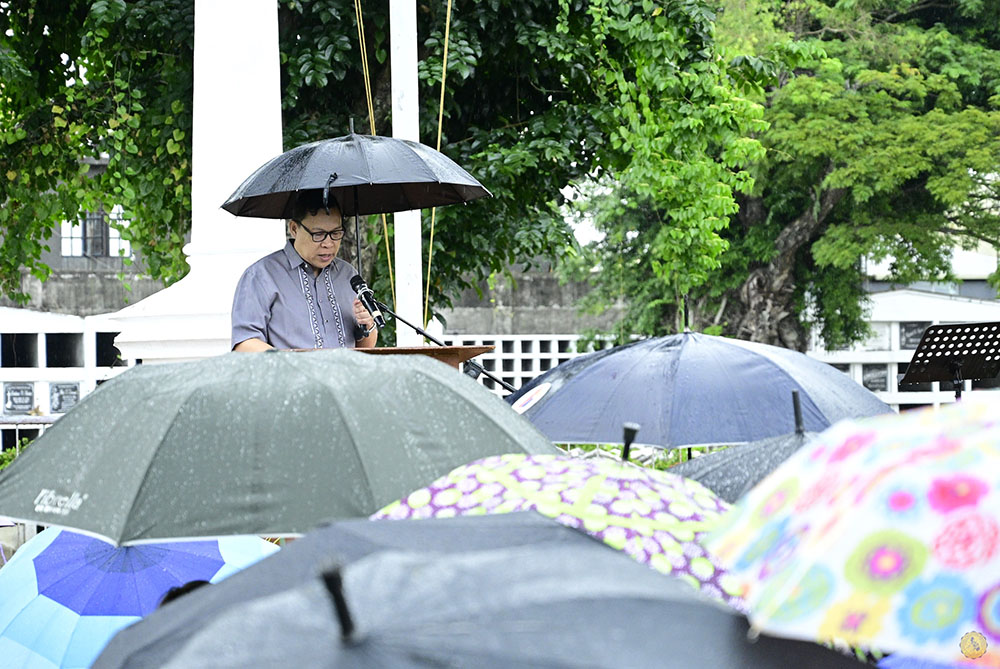
Rev. Dr. Francis Neil G. Jalando-on, Director of the Office of Communications, shared a brief reflection on Central Philippine University’s 121-year history during the Wreath-Laying and Memorial Service at the Philippine-American Cemetery.
Today, October 1, as Central Philippine University celebrates its 121st Foundation Day, we gather in a place of remembrance.
Around us are the names and graves of people who were part of the story of this institution. Some of them came from thousands of kilometers away. Some were born here in Panay. Some stayed only for a few years. Others gave their entire lives to the mission.
And so, as we speak of the 121 years of Central Philippine University, let us begin not in 1905, but in 1898.
In Barcelona, Spain, a Swedish Baptist missionary named Rev. Dr. Eric Lund met a Filipino from Aklan named Braulio Manikan. Lund baptized Manikan, making him the first Filipino Baptist. The two began translating the Gospels and the Book of Acts into Hiligaynon while waiting for an opportunity to carry the Baptist faith to the Philippines.
That opportunity came in May 1900.
Lund and Manikan arrived in Iloilo, bringing with them a vision that would eventually give birth not only to churches, but also to hospitals and schools. Their mission was patterned after the ministry of Jesus Christ: preaching, healing, and teaching.
The preaching ministry established churches. The healing ministry established hospitals. And the teaching ministry would eventually give birth to Central Philippine University (Jalando-on, 2026).
Perhaps this is one of the most important things to remember about our history.
Central did not begin as a university.
Central began as a mission.
It began with two men who believed that the Gospel had to be communicated in the language of the people. It grew from a missionary vision that believed that the whole person must be served: spiritually, intellectually, physically, and socially.
Then came the schools.
In 1904, the Philippine Baptist Mission Conference decided to establish an industrial school for boys and a Bible school for pastors. The Bible School for men opened in June 1905.
Then, on October 1, 1905, the Jaro Industrial School opened with 20 boys.
At the center of this effort was Rev. Dr. William Orison Brown Valentine, principal from 1905 to 1906 and again from 1907 to 1914 (Jalando-on, 2025).
Valentine believed that education should not be separated from work. The boys studied for part of the day and worked for their board and tuition for the other part. The philosophy was simple but revolutionary: “Labor is Honor.”
The school was training not merely the minds of young Filipinos, but also their hands, character, and sense of responsibility. By 1907, enrollment had grown to nearly 300, and the school had already organized what became the Jaro Industrial School Republic, now remembered as the beginning of the CPU Republic (Jalando-on, 2026).
At about the same time, another school was taking shape, and it is easy to forget.
In 1904, Missionary Anna V. Johnson began teaching the Bible to women in her own living room. On October 20, 1905, she opened the Baptist Missionary Training School, known as the BMTS, in the residence of Missionary Briggs (Jalando-on, 2019).
The women trained there were called “Bible Women.” They spent six months in the school and six months in the field, where they taught, preached, opened Sunday schools, and helped organize churches across rural Western Visayas. From 1908 to 1914 alone, 229 women were trained (Jalando-on, 2019).
Johnson died on June 7, 1930, and was buried in the American Cemetery in Jaro (Jalando-on, 2019).
At the Jaro Industrial School, Valentine was followed and assisted through the early years by a succession of leaders.
Rev. Charles L. Maxfield served as an early acting principal from 1906 to 1907. Rev. Dr. Francis Howard Rose served several times in the early administration of the school: 1914 to 1916, 1931 to 1932, and 1938 to 1941. Rev. Henry Weston Munger served from 1916 to 1917, and Miss Mary Jane Thomas, one of the first women to lead the institution, served as acting principal from 1917 to 1918 (Central Philippine University, 2005a, 2005b, 2005c, 2025; Jalando-on, 2025, 2026).
But Rose deserves a special place in our memory.
Rev. Dr. Francis Howard Rose was a pastor, educator, scientist, carpenter, artist, writer, musician, fundraiser, and administrator. He taught several subjects, designed buildings, supervised the electric plant, wrote poetry and music, raised funds, and worked tirelessly for the institution.
But Rose gave Central something more than administration.
He helped give Central an identity.
In 1923, he designed the CPU Seal, with its twelve rays symbolizing the twelve tribes of Israel and the twelve disciples. He composed Central Songs and helped establish the term “Central Spirit.”
He also established the green-and-white campus color tradition. That tradition remains visible in the color of many of our buildings today. Alongside that campus tradition, the gold and blue became the institutional colors of Central.
In other words, even before Central became a university, Rose was helping shape not only what the institution believed, but how it looked, sounded, and identified itself.
Then came Dr. Alton Ezra Bigelow, who served as acting principal from 1918 to 1922. Bigelow was a preacher, teacher, printer, translator, and linguist. He could speak five languages. He produced a 555-page Visayan-English and English-Visayan dictionary containing more than 14,000 entries.
But perhaps his most lasting contribution to Central was theological education.
In 1926, the School of Theology was formally established under Bigelow’s leadership. One hundred years later, in 2026, we celebrate the centennial of that institution.
The College of Theology therefore carries a story that reaches even farther back than its formal establishment. Its roots can be traced to the Bible schools established in the earliest years of the Baptist mission (Central Philippine University, 2025; Jalando-on, 2026).
Among those roots was the BMTS. In October 1938, it merged with Central Philippine College as the Women’s Division of the College of Theology. Johnson Hall, built in 1939 and rebuilt after the war in 1950, bears the name of Anna V. Johnson (Jalando-on, 2019).
Dr. Harland Francis Chandler Stuart, who served from 1922 to 1938, then led Central into another significant transformation.
Under Stuart, the school moved from its original industrial-school identity toward a broader collegiate institution. Coeducation was extended, new academic programs were developed, and the physical campus expanded.
Jaro Industrial School became Central Philippine School and then Central Philippine College.
The institution was no longer simply training boys for practical work. It was becoming a college capable of preparing teachers, business people, engineers, theologians, nurses, and other professionals (Jalando-on, 2026).
And then came the darkest chapter in our history.
World War II.
Central Philippine College was devastated by war. Many students, faculty, and alumni joined the resistance. Academic records were hidden and protected. And in Hopevale, Tapaz, Capiz, American Baptist missionaries and a young boy sought refuge.
Among them was Rev. Dr. Francis Howard Rose, who had served as acting president before the war, and his wife, Gertrude.
On December 20, 1943, the Hopevale Martyrs were killed.
Rose, who had served Central in several capacities, became not only part of our institutional history but part of our theology of sacrifice.
His words in The Martyr’s Antiphony are remembered: “For every gain for Christendom, is bought by someone’s martyrdom.”
When liberation came, President Rev. Dr. R. Fred Hertling Chambers, who had served as president from 1941 to 1942, returned to Central in 1945 after internment at the Santo Tomas Internment Camp.
He saw the campus in ruins.
The buildings were destroyed. The institution had been devastated by war.
And yet, standing among those ruins, Chambers declared: “From these ashes shall rise a greater Central.”
Those words would become one of the most enduring statements in our history (Central Philippine University, 2025).
The statement was not merely about rebuilding buildings.
It was about rebuilding a mission.
It was about believing that Central’s spirit was greater than the destruction around it.
Rev. Dr. Joseph Morris Rickey Forbes, acting president from 1947 to 1950, helped lead that reconstruction. Forbes was known as a thinker and philosopher, but also as a practical worker. He worked alongside laborers and urged students to “THINK.”
Rev. Dr. Peter Hugh James Lerrigo, who served from 1950 to 1952, returned from retirement to help rebuild Central. He was the only surviving incorporator of Jaro Industrial School. Under his leadership, new buildings were constructed, academic programs were strengthened, student life was revived, and Rose Memorial Hall was built to honor the Hopevale martyrs.
Then came Dr. Almus O. Larsen, who served from 1952 to 1961.
Larsen led Central through one of the most important transitions in its history.
On April 1, 1953, Central Philippine College officially became Central Philippine University.
The school that began with 20 boys in 1905 had become a university.
Larsen emphasized scholarship, student welfare, a Biblical center for life, engagement with the realities of the times, and confidence in eternity.
He also gave Central the guiding motto that remains associated with the university: “Education for Service” (Jalando-on, 2026, Postwar Rebuilding and University Status section).
Dr. Linnea Agnes Nelson also belongs to this important generation. She served as acting president in 1956 to 1957 and again in 1965 to 1966. She was a scholar, educator, and leader who emphasized understanding the needs of young people and their communities. She later became one of the authors of Scientia et Fides: The Story of Central Philippine University and challenged generations of Centralians to become both “Dreamers and Builders” (Central Philippine University, 2025; Jalando-on, 2026, Postwar Rebuilding and University Status section).
Rev. Dr. Joseph Turner Howard, who served from 1961 to 1965, was known to many as “Tatay Joe.” His leadership represented another step in the Filipinization of Central. He taught in Hiligaynon and identified deeply with Filipino life and culture.
Then came a historic turning point. In 1966, Dr. Rex Divinagracia Drilon became the first Filipino president of Central Philippine University, serving from 1966 to 1971.
The transition from American missionary leadership to Filipino leadership was not simply a change of nationality. It was a sign that the institution had matured.
Drilon envisioned “A Great Central.” He promoted academic freedom, encouraged free expression, established the University Research Center, and strengthened Central’s scholarly life.
Then, on Christmas Day in 1969, something extraordinary happened.
The American Baptist Foreign Mission Society transferred the entire university property to the Filipino Corporation of Central Philippine University.
Central was now fully entrusted to Filipino leadership and stewardship.
The mission that had come from abroad had become a Filipino institution (Jalando-on, 2026).
After Drilon came Dr. Agustin A. Pulido, who served from 1971 to 1996.
Pulido was only 39 when he became president, and he would serve for 25 years, the longest presidency in CPU history.
A chemist by training, he once described the presidency as requiring “a different and higher level of chemistry.”
Under Pulido, Central expanded its academic programs, strengthened accreditation, developed international linkages, improved research and graduate education, expanded the library and infrastructure, and strengthened relationships with alumni around the world.
His administration helped establish the foundation for a stronger and more academically recognized Central (Jalando-on, 2026).
After 25 years, Pulido passed the leadership of the university to Dr. Juanito Maca Acanto.
Acanto served through the transition from 1996 to 2008, first as OIC beginning in 1996, then as Acting President in 1997, and as regular president beginning in 1998 (Central Philippine University, 2025).
Acanto’s story is different. He became president during an unexpected leadership transition. He later summarized his qualification in a single sentence: “My best qualification was availability and faith.”
His presidency became a period of rapid expansion and preparation for the Centennial in 2005.
New programs and colleges were established. The College of Medicine and College of Computer Studies opened. Infrastructure expanded. Alumni relationships became stronger. The Centennial Endowment Fund generated significant resources. Central gained autonomous status and its first ISO certification.
But beyond buildings and programs, Acanto helped articulate something that remains central to our identity.
EXCEL: Exemplary Christian Education for Life.
During his administration, the Core Values of Faith, Character, Justice, Stewardship, and Excellence were formalized.
And his vision for Central was memorable: “I envisioned CPU as a beauty to behold, a beauty to think and feel about, and a beauty to be remembered.”
The Centennial became a celebration not simply of how old Central was, but of how much of its heritage could be carried into the future (Jalando-on, 2026).
Then came Dr. Teodoro C. Robles, who served from 2008 to 2023.
Robles was himself a product of the Central tradition. He came through engineering and worked as a student to support his education. He later pursued advanced studies abroad and established a distinguished career in engineering, research, and technology.
When he became president, Central entered another period of innovation and institutional strengthening.
During his 15-year presidency, CPU maintained autonomous status, advanced accreditation, strengthened international partnerships, expanded research, and continued improving its physical campus and academic programs.
His leadership demonstrated another important dimension of the Central Spirit: stewardship.
Central had inherited much from previous generations. It also had to protect what had been entrusted to it and prepare it for those who would come next (Jalando-on, 2026).
In 2023, the university entered another historic chapter. Rev. Dr. Ernest Howard B. Dagohoy became the 18th President of Central Philippine University on November 1, 2023, serving a term through October 31, 2028 (Central Philippine University, 2025; Jalando-on, 2026).
His election represented another important chapter in the story of the institution. He became the first Filipino pastor to hold the presidency since the period of American Baptist missionary leadership.
He is also a Centralian, a graduate of CPU Development High School and the College of Theology, an ordained minister of the Convention of Philippine Baptist Churches, a former faculty member of the College of Theology, former University Chaplain, and a pastor who spent years serving the Filipino Baptist community abroad (Central Philippine University, 2025; Jalando-on, 2026).
And so, here we are.
One hundred twenty-one years after those 20 boys entered the Jaro Industrial School.
One hundred twenty-one years after Valentine taught that labor is honor.
One hundred twenty-six years after Lund and Manikan arrived in Iloilo.
One hundred years after the formal establishment of the School of Theology.
Eighty-three years after Hopevale.
Seventy-three years after Central became a university.
Sixty years after the first Filipino president took the helm.
Fifty-seven years after the university was entrusted to Filipino stewardship.
Twenty-one years after the Centennial.
And nearly three years into the presidency of our 18th president.
Today, Central serves approximately 15,000 students, with more than 1,000 faculty and staff. The university continues to hold CHED Autonomous Status, presently renewed from September 16, 2024 to September 15, 2027, and in 2025 transitioned to ISO 21001:2018, an education-specific management system (Central Philippine University, 2025; Jalando-on, 2026).
But standing here among the graves of those who came before us, we are reminded that numbers, buildings, programs, rankings, and recognitions are not the whole story.
The deeper story is people.
Lund and Manikan.
Valentine.
Johnson.
Maxfield.
Rose.
Munger.
Thomas.
Bigelow.
Stuart.
Chambers.
Forbes.
Lerrigo.
Larsen.
Nelson.
Howard.
Drilon.
Pulido.
Acanto.
Robles.
Dagohoy.
And thousands upon thousands of faculty, staff, students, alumni, missionaries, pastors, donors, parents, workers, trustees, and friends who each carried a small part of the Central story.
This year’s theme is therefore deeply appropriate: Central Spirit: Uniting Generations.
The Central Spirit is not something that belongs only to the generation of 1905.
It is not something that belongs only to the missionaries. It does not belong only to the presidents. It does not belong only to alumni.
The Central Spirit is what connects the generations.
It is the faith of Lund and Manikan.
It is the dignity of labor taught by Valentine.
It is the devotion of Anna Johnson and the Bible Women.
It is the creativity of Rose.
It is the theological vision of Bigelow.
It is the courage of the Hopevale martyrs.
It is the resilience embodied by Chambers’ declaration that from these ashes would rise a greater Central.
It is Drilon’s Great Central.
It is Pulido’s pursuit of academic excellence.
It is Acanto’s availability and faith.
It is Robles’ stewardship and innovation.
It is Dagohoy’s pastoral leadership.
And now, it is ours.
The question before us on this 121st Foundation Day is not only, “What did Central become?” The more important question is: “What will we do with the Central that has been entrusted to us?”
Those buried here cannot continue the work. We can.
They cannot teach another generation. We can.
They cannot build another classroom, mentor another student, write another book, preach another sermon, conduct another research project, serve another community, or welcome another young person through the gates of Central. We can.
So today, we remember the dead. We honor the past. But we challenge the living. May we not merely inherit the Central Spirit. May we carry it.
May we unite generations by remembering where we came from, understanding who we are, and faithfully preparing the way for those who will come after us.
From Barcelona to Iloilo. From Jaro Industrial School to Central Philippine University.
From twenty working boys to thousands of students. From mission school to university.
From the ashes of war to a greater Central. From one generation to another.
The story continues. And today, that story is in our hands.
Happy 121st Foundation Day, Central Philippine University.
Central Spirit: Uniting Generations.
May we remain rooted in faith, driven by excellence, and faithful to the mission entrusted to us. May God bless and keep us all.
References:
Central Philippine University. (2005a). Wall of Remembrance: Charles L. Maxfield [Posthumous service award citation and awardee’s information sheet; unpublished document].
Central Philippine University. (2005b). Wall of Remembrance: Henry Weston Munger [Posthumous service award citation and awardee’s information sheet; unpublished document].
Central Philippine University. (2005c). Wall of Remembrance: Mary Jane Thomas [Posthumous service award citation and awardee’s information sheet; unpublished document].
Central Philippine University. (2025, October 16). Presidents. https://cpu.edu.ph/about-us/administration/presidents/
Jalando-on, F. N. G. (2019, April 12). Anna V. Johnson and the “Bible Women”. Central Philippine University. https://cpu.edu.ph/news/anna-v-johnson-and-the-bible-women/
Jalando-on, F. N. G. (2025, September 27). Celebrating 120 years of Central Philippine University: The acting principals who carried the torch. Centralian Link. https://cpu.edu.ph/news/celebrating-120-years-of-central-philippine-university-the-acting-principals-who-carried-the-torch/
Jalando-on, F. N. G. (2026, July 17). Brief history of Central Philippine University. Central Philippine University. https://cpu.edu.ph/about-us/history/