
By Francis Neil G. Jalando-on
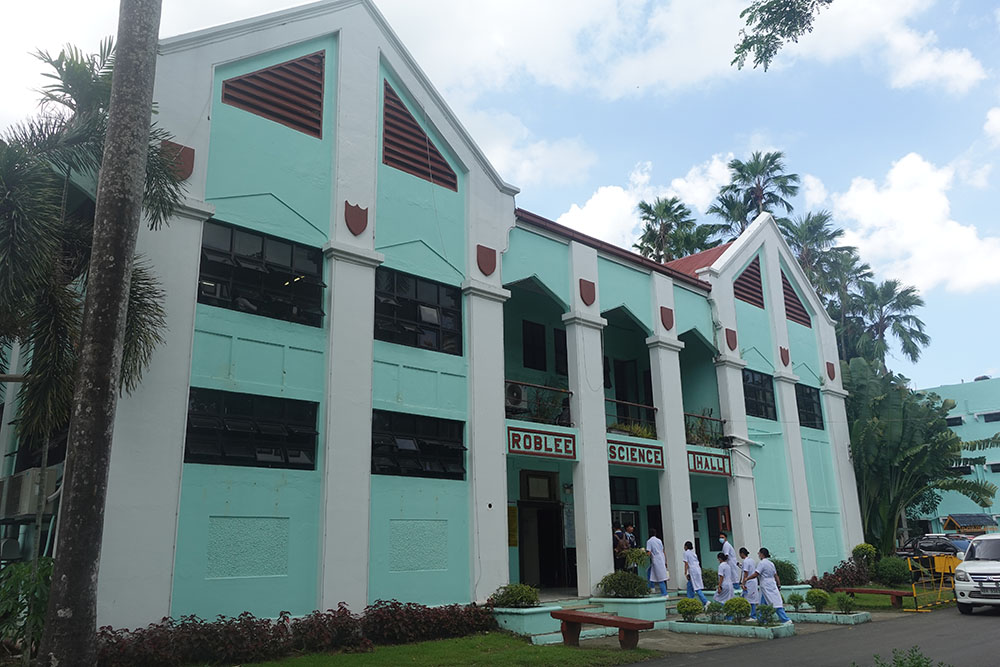
The green and white facade of Roblee Hall reflecting the unified colors of Central– a story older than us and a part of CPU’s identity.
As we celebrate the 121st Foundation Day of Central Philippine University, let me ask a question: “Have you ever wondered about the color of the buildings of Central Philippine University?” Why are so many of them painted in that familiar, light mint green?
It is a color so ordinary to Centralians that we hardly notice it anymore. We pass by it every day, in classrooms, offices, halls, and buildings across the campus. For generations, it has simply been part of what Central looks like.
But there is a story behind that color, and surprisingly, it takes us back to one of the most extraordinary men in the history of Central Philippine University: Rev. Dr. Francis Howard Rose.
A scientist, a pastor, a missionary, an educator, a builder, a musician, an architect, a poet, a composer, and, ultimately, a martyr.
Dr. Rose seems almost impossible to fit into a single description. CPU’s own historical record describes him as a man of remarkable versatility, teaching science, music, and theology while also designing buildings, writing poetry, composing songs, supervising construction, and serving the institution in several leadership capacities. Perhaps it was precisely this unusual combination of science, faith, art, and practicality that gave Central some of the visual and cultural identity it carries to this day.
Scientia et Fides
Before we talk about green, we need to talk about gold and blue, because the story begins with the CPU Seal.
In 1923, Dr. Francis Howard Rose designed the seal of what was then Central Philippine School. It was adopted by the Board of Trustees in 1924. At its heart was the Latin expression Scientia et Fides, Science and Faith. The seal was not merely an artistic creation; it was a declaration of what Central believed education should be: knowledge and faith, learning and Christian commitment, the life of the mind and the life of the spirit.
CPU’s Constitution and By-Laws eventually enshrined the University’s seal and its colors. Article IX states that the seal “bears the University colors gold and blue,” with the letters, map, lines, and stars appearing in blue against gold. So gold and blue are not merely attractive colors selected for school shirts or banners; they belong to Central’s institutional identity. Gold and blue are Central.
Gold and Blue Were Sung Before They Were Seen
But here is something even more beautiful: Central’s colors were not confined to a seal or a legal document. They were sung.
Dr. Rose composed many of the Central Songs and helped create the musical culture that became part of the Centralian experience. CPU’s historical account even describes him as a gifted musician who composed many of the songs still remembered today. One of the enduring titles in the Central Songs collection is “The Gold and Blue.” The song speaks of the Centralian bond, loyalty to Central, and the heritage carried beyond the university halls. The official collection describes these songs as songs of faith, expressing the “Central Spirit” that binds generations of Centralians together.
There is something profound about that. Central did not merely wear its colors; Central sang them. Gold and blue became part of the emotional vocabulary of generations of students. And in the University’s institutional life, those colors came to carry meaning: gold speaks of excellence, blue speaks of spirituality. Scientia and Fides. Excellence and spirituality. Gold and blue.
Then There Was Green
Now comes the mystery: if gold and blue are the official University colors, where did the green come from? Why are Central’s buildings green?
The answer is actually documented. CPU’s official history says that Dr. Rose “established the green-and-white campus color tradition.” Another CPU historical account describes how, in 1915, Rose unified the campus appearance by painting its buildings green with white trim. So the green is not a recent branding decision; it reaches deep into Central’s history. It came through Rose, the man who designed the seal, the man associated with Scientia et Fides, the man who composed Central Songs, the man who coined “Central Spirit,” the man who helped shape the physical campus, and the man who decided that the buildings of Central should be green.
But what about the particular shade we see today? That is where the story becomes fascinating.
The Mint-Green Question
The historical sources establish that Rose created the green-and-white campus tradition, but they do not appear to preserve a precise paint formula explaining why the green took the particular light, almost mint-like shade that generations of Centralians recognize today. And this is where an intriguing possibility emerges.
Consider the three colors that repeatedly appear in Central’s visual identity: gold, blue, and white. But let us be clear: white is not being proposed here as a third official University color. The CPU Constitution and By-Laws identify gold and blue as the University colors. White is the accompanying color that appears in the seal and in the green-and-white campus treatment.
Now imagine the colors conceptually. Gold and blue, when combined, move toward green. Add white, and that green becomes lighter, softer, more subdued, more like the familiar mint green of the Central campus. And suddenly, something remarkable happens: the green begins to look like a visual meeting point between the University’s defining colors and the white that accompanies them.
Could This Be the Secret?
Was this actually Dr. Rose’s intention? We cannot say that yet. There is no surviving document presently available that says Rose deliberately calculated the campus green by mixing gold, blue, and white. So this should remain what it is: a historical hypothesis, not an established fact.
But what a fascinating hypothesis it is. Because if it were intentional, Dr. Rose may have done something extraordinarily clever. He would have given Central two official colors, gold and blue, and given those colors meaning: excellence and spirituality. He would have given the University a motto, Scientia et Fides. He would have given it a seal. He would have given it songs. He would have helped give it a physical identity through green buildings. And perhaps, in the most subtle way, he gave Central a color that visually brings everything together: gold, blue, and white, becoming green.
The Genius of Francis Howard Rose
Think about the man who was behind all this. Rose was a scientist and a pastor, and that combination is important: he did not see science and faith as enemies. He put them together. Scientia et Fides.
He was an educator and a builder, so he did not simply teach Centralian students; he helped build the physical environment in which they would learn. He was a musician, so he did not simply establish academic traditions; he helped give Central a voice through its songs. He was a missionary, so the symbols and traditions he created were ultimately connected to a Christian mission. And he was an artist and designer, so perhaps he understood something that we sometimes forget: a university does not communicate only through words. It communicates through symbols, through buildings, through songs, through colors, through memories, through things people see every day without even thinking about them.
Look Again
The next time you drive through the CPU campus, look again. Look at the green. It is easy to dismiss it as simply paint, but it is older than most of us. It was part of Rose’s effort to create a unified campus appearance more than a century ago.
Then look at the seal: gold and blue, Scientia et Fides, Science and Faith. Then listen to the songs: “The Gold and Blue,” the Central Spirit, songs that have carried the memory of Central from one generation to another. Then look at the buildings again: green, soft, distinctive, familiar, Central.
Perhaps the Color Has Been Telling the Story All Along
Maybe the green is simply the result of an early campus color decision made by Dr. Rose. That alone makes it historically significant. But perhaps there is another layer. Perhaps the mint green is a beautiful visual coincidence, or perhaps, somewhere in the creative mind of a scientist, pastor, missionary, musician, builder, and designer, there was an understanding that colors could speak even when words were silent: gold for excellence, blue for spirituality, white the quiet companion, and green the color that fills the campus where excellence and spirituality are lived.
We may not yet have the document that proves the formula, but the possibility is beautiful. And if one day an old document, photograph, notebook, or record is discovered that confirms that Rose deliberately conceived the campus green from Central’s colors, we may look at our campus very differently. Because then the color we have been walking past for generations would not simply be green; it would be a visual synthesis of Central’s identity: Scientia et Fides, gold and blue, excellence and spirituality.
And then, green. Perhaps Dr. Francis Howard Rose was telling us something more than we realized. Perhaps the genius was hiding in plain sight. All we had to do is look at the color and ask: “Why is Central green?”