
By CPU CARES
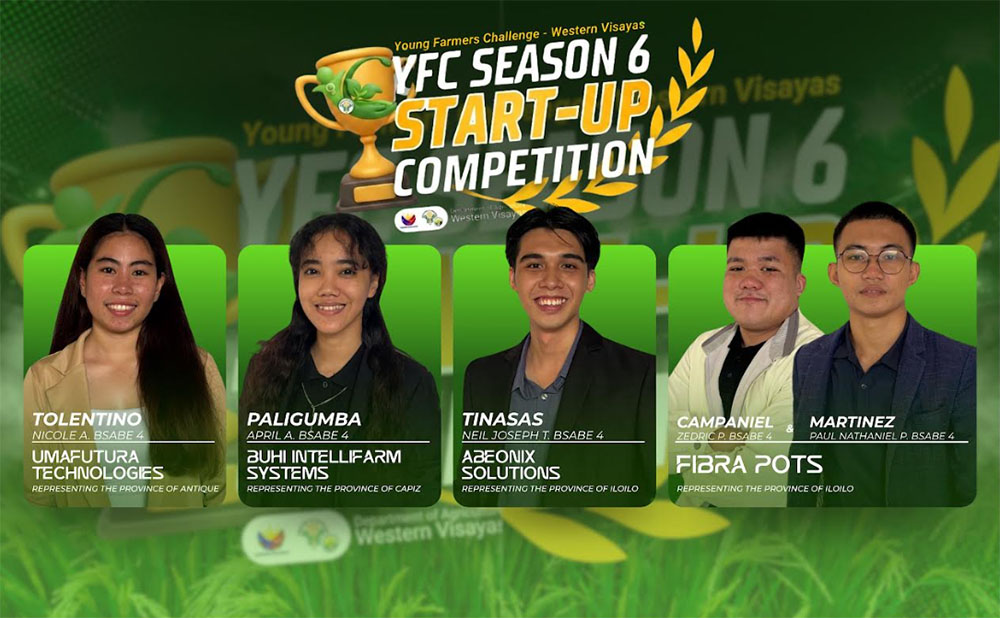
Congratulations to the five CPU-BSABE students for earning provincial recognition in the DA’s Young Farmers Challenge – Western Visayas, Start-Up Category, and for advancing their innovative agri-fishery ventures to the regional level! Photo credits to Young Farmers Challenge – Western Visayas.
Five students from the BS Agricultural and Biosystems Engineering (BSABE) program, under the Department of Agricultural Engineering and Environmental Management of the College of Agriculture, Resources and Environmental Sciences (CPU-CARES), have qualified as Provincial Awardees in the Department of Agriculture’s (DA) Young Farmers Challenge (YFC) – Western Visayas, Start-Up Category, across four entries.
The DA-Western Visayas announced the provincial-level results covering the region’s provinces, with the following CPU-BSABE student entries earning recognition:
- Nicole A. Tolentino, BSABE-4 — 𝘜𝘮𝘢𝘧𝘶𝘵𝘶𝘳𝘢 𝘛𝘦𝘤𝘩𝘯𝘰𝘭𝘰𝘨𝘪𝘦𝘴, Province of Antique
- Zedric P. Campaniel, BSABE-4 and Paul Nathaniel P. Martinez, BSABE-4 — 𝘍𝘪𝘣𝘳𝘢 𝘗𝘰𝘵𝘴, Province of Iloilo
- Neil Joseph T. Tinasas, BSABE-4 — 𝘈𝘣𝘦𝘰𝘯𝘪𝘹 𝘚𝘰𝘭𝘶𝘵𝘪𝘰𝘯𝘴, Province of Iloilo
- April A. Paligumba, BSABE-4 — 𝘉𝘶𝘩𝘪 𝘐𝘯𝘵𝘦𝘭𝘭𝘪𝘍𝘢𝘳𝘮 𝘚𝘺𝘴𝘵𝘦𝘮𝘴, Province of Capiz
The Young Farmers Challenge is a nationwide competitive grant program of the DA that supports Filipinos aged 18 to 30 in developing agri-fishery enterprises, combining financial assistance with business development support such as training, mentoring, and market linkages. As provincial awardees, the four BSABE students now advance to the regional level of the Start-Up Category competition.
The department has continued to encourage its students to translate their engineering and agribusiness training into ventures that address real needs in the agriculture and food processing sectors, in line with the university’s mission of forming graduates equipped for service and innovation in the field.
For the Department of Agricultural Engineering and Environmental Management of CPU-CARES, the results reflect a deliberate direction in its research and innovation work: that ideas developed inside the classroom and laboratory are meant to reach farmers and communities, not remain as academic exercises. The four qualifying ventures were developed with that same principle in mind — practical, community-grounded solutions to problems in agri-fishery production, processing, and enterprise development.