By Mikee Natinga Norico
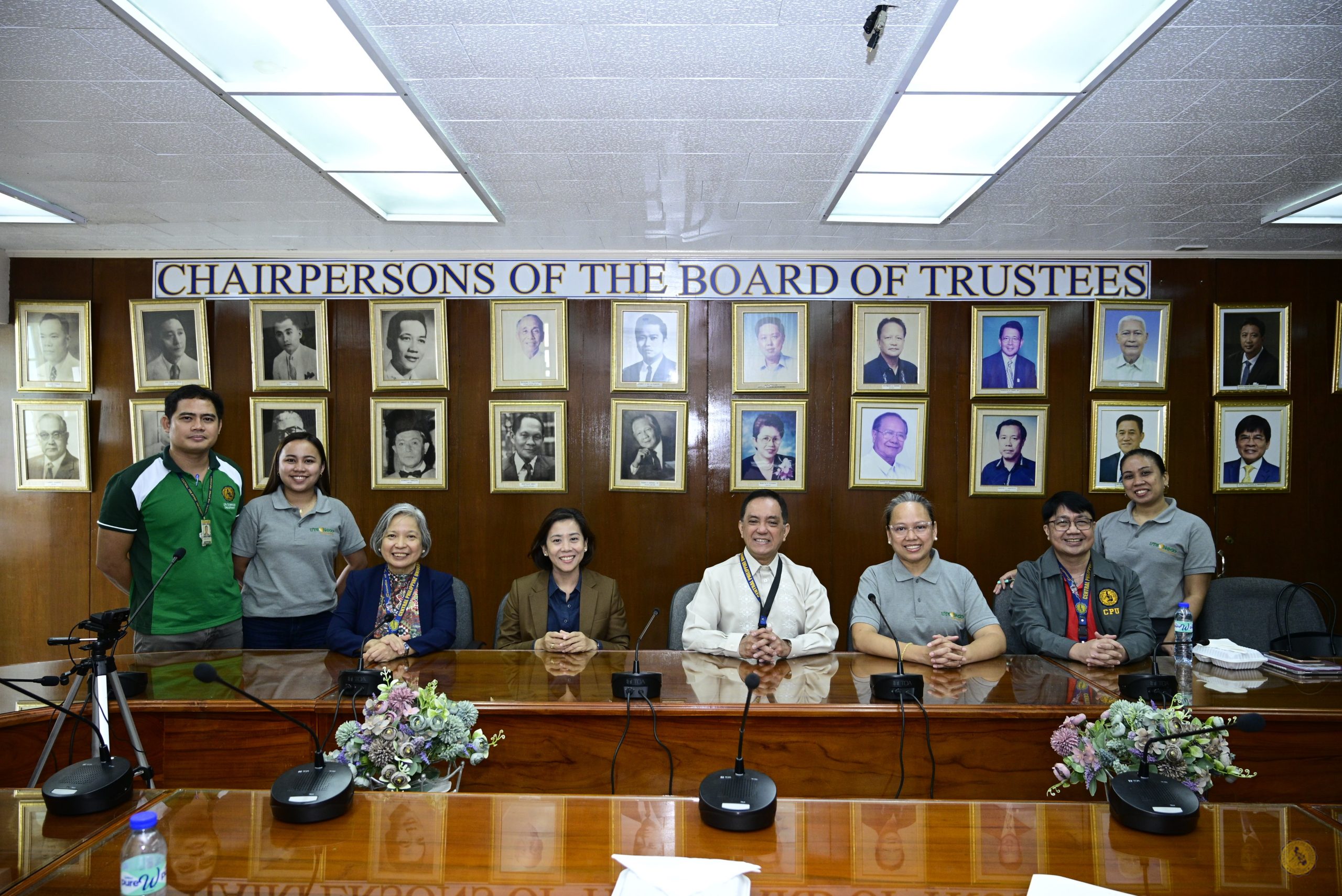
University President Rev. Dr. Ernest Howard B. Dagohoy, along with CPU representatives, gathers for a group photo with Uygongco Foundation Inc. Executive Director Hannah Carla Crisostomo, Finance and Administration Officer Mary Joy Salvacion, and OIC Program Officer Claudine Bacod following the courtesy call and collaboration meeting at the BOT Conference Room.
On August 3, 2026, Central Philippine University (CPU) welcomed representatives of Uygongco Foundation Inc. for a courtesy call and collaboration meeting to explore potential partnerships in scholarships, community development, research, and student engagement at the BOT Conference Room.
The meeting was led by University President Rev. Dr. Ernest Howard B. Dagohoy, who welcomed Uygongco Foundation Inc. Executive Director Hannah Carla Crisostomo, Finance and Admin Officer Mary Joy Salvacion, and Officer-in-Charge Program Officer Claudine Bacod. Also present were Dr. Aries Roda D. Romallosa, Acting Vice President for Research, Development, and Extension (VPRDE); Dr. Dimpna Castigador, Director of the Office of Institutional Advancement; Asst. Prof. Sarex Dalida Dipol, Jr., Director of the Community Engagement and Service-Learning Center (CESLC); and Pastor Alfred C. Morales, Director of the Student Development and Programs Office (SDP).
In his welcome remarks, Rev. Dr. Dagohoy expressed appreciation for the generosity of the Uygongco family and its contributions to CPU over the years. He reflected on how the family’s support has benefited generations of students and emphasized that investments in education create lasting impacts that extend far beyond the present generation.
Uygongco Foundation Inc. Executive Director Hannah Carla Crisostomo presented the Foundation’s mission, current programs, and proposed areas for collaboration with the University. She shared that the Foundation currently supports approximately 1,600 scholars nationwide, with five scholars presently enrolled at CPU.
The Foundation’s scholarship program provides up to eight years of support, including four years of college education, one year of board examination review assistance, and three years of employment support, enabling students to continue receiving assistance until they become licensed professionals and secure employment. Priority degree programs include Civil Engineering, Chemical Engineering, Mechanical Engineering, Electrical Engineering, Packaging Engineering, Accountancy, Agriculture, and Information Technology.
The Foundation also expressed interest in partnering with CPU to enhance scholarship promotion and identify deserving but financially challenged students before the start of each academic year.
Beyond scholarships, the Foundation presented several initiatives where the University’s expertise could provide valuable support. Among these is its school feeding program, which currently serves approximately 300 children in three public schools for 200 days each year. The Foundation requested CPU’s assistance in nutrition planning, children’s health and nutrition monitoring, impact assessment, and the development of more effective evaluation tools.
The Foundation likewise proposed establishing a structured volunteer program that would engage CPU students, particularly those from Social Work, Education, and other relevant academic programs, in community engagement, program implementation, data collection, monitoring and evaluation, and impact assessment.
Additional areas discussed for possible collaboration included school feeding, school gardening, nutrition education, literacy and numeracy enhancement, technology transfer, community-based research, and technical and vocational education.
In response, University officials presented existing programs that complement the Foundation’s initiatives, including CPU’s research, development, and extension programs, technology transfer initiatives, communication and information dissemination efforts, disaster response initiatives, and partnerships with local government units and partner communities.
The University also highlighted its ongoing community engagement initiatives, which include community needs assessments, livelihood development, women’s organizations, social welfare services, health programs, educational interventions, and Gender and Development (GAD) initiatives. Officials further shared CPU’s efforts to expand technical and vocational education through TESDA-related certifications, technical skills training, micro-credential programs, industry partnerships, engineering certifications, and Packaging Engineering initiatives.
The meeting concluded with both parties expressing enthusiasm for pursuing future collaborations, recognizing their shared commitment to advancing education, community development, and sustainable social impact. CPU also committed to continuing discussions with the Foundation to identify concrete collaborative initiatives that may be implemented in the future.