By Francis Neil G. Jalando-on
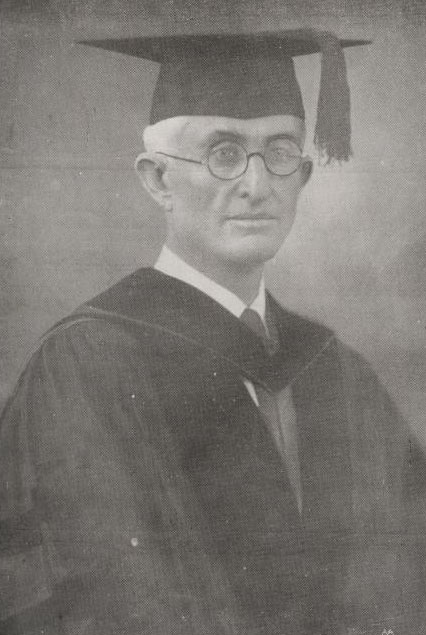
Rev. Dr. Alton Ezra Bigelow’s legacy lives on through the Alton Bigelow Alma Mater Award, the highest honor of Central Philippine University bestowed upon graduates who exemplify excellence in scholarship, leadership, service, ministry, and Christian character.
Every university reveals its deepest values through the names it chooses to honor its buildings, memorials, and awards. They embody the ideals an institution desires future generations to imitate. At Central Philippine University, the highest distinction granted to a graduating student is the Alton Bigelow Alma Mater Award. This naturally raises a profound question: Why Alton Ezra Bigelow?
Why would CPU choose the name of a missionary educator from the early twentieth century to represent the highest ideal of a Centralian graduate?
The answer may be found not merely in what Alton Bigelow accomplished, but in what he came to symbolize in the life and soul of Central Philippine University itself.
Rev. Dr. Alton Ezra Bigelow was far more than a teacher or missionary. He was a theologian, linguist, editor, administrator, institution builder, mentor, and visionary. Arriving in Iloilo in 1907 under the American Baptist Foreign Mission Society, Bigelow devoted nearly three decades of his life to the Philippines. He became one of the original incorporators of the Jaro Industrial School, later served as Acting Principal from 1918 to 1922, founded the School of Theology in 1926, edited the first Hiligaynon Protestant newsletter, revised the Hiligaynon Bible, and helped shape the Christian culture of the campus.
Yet many missionaries served CPU faithfully. Why then was Bigelow singled out for the university’s highest recognition? Perhaps because Bigelow represented the complete integration of CPU’s motto: Scientia et Fides, Science and Faith.
His life united intellectual excellence with Christian discipleship in a manner that is rarely seen. Historically, Bigelow was not only concerned with producing educated students. He was deeply concerned about producing transformed people.
One of his surviving theological statements reveals this clearly. In one remarkable declaration, Bigelow wrote: “I believe that the development of character is man’s most fundamental concern.” He further stated: “This development can only be achieved in proportion as man gives himself in service to others.” These words are deeply significant because they precisely reflect the spirit embodied in the Alton Bigelow Alma Mater Award. The award does not recognize academic excellence alone. Rather, it honors a student who excels in academics, leadership, extracurricular involvement, and Christian ministry.
The award also reflects Bigelow’s theology of education. For Bigelow, education was never merely the transfer of information. Education was the formation of Christian character through service, faith, discipline, and moral responsibility. He believed that intellectual achievement without spiritual formation was incomplete.
Another statement from Bigelow reveals the Christ-centered foundation of his philosophy: “I believe that Jesus Christ is the concrete revelation of this character of God.” This theological conviction explains why Bigelow invested not only in classrooms but also in worship life, church life, and student ministry. In 1913, he organized what became known as the “school church” on campus. Students led prayers, Scripture reading, choir music, and worship participation. This eventually developed into what later became the University Church.
In many ways, Bigelow was attempting to build not simply a school but a Christian community.
His intellectual contributions were equally remarkable. Bigelow was a gifted linguist who reportedly spoke five languages. He produced a monumental 555-page Visayan-English and English-Visayan Dictionary containing more than 14,000 entries, one of the earliest major linguistic works on Hiligaynon and Visayan usage. He also published a Visayan grammar book in 1913.
At the request of the American Bible Society, he revised the Hiligaynon Bible originally translated by Rev. Eric Lund and Rev. Braulio Manikan. He likewise collaborated with Mrs. J. A. Hall in producing an Ilonggo hymnal in two editions: one with musical notation and another containing text only. These are major achievements.
Bigelow helped shape the intellectual and spiritual language of Protestant Christianity in Western Visayas. Through his dictionaries, grammar books, Bible revisions, and hymnals, he contributed to the preservation, systematization, and theological use of Hiligaynon itself. Rev. Dr. Francis Howard Rose later observed that Bigelow “did much to shape the theology of churches and the opinion of the public on Protestant churches.”
His influence extended beyond theology and education into the physical environment of CPU. Bigelow loved plants, trees, and campus beautification. Historical accounts credit him with planting the Traveler’s Palm near Roblee Science Hall, the Anahaw trees along the road between Lopez Hall and Weston Hall, and the Royal Palms in front of the old Rose Memorial Auditorium. These details may seem small at first glance, yet they are profoundly symbolic.
Bigelow planted institutions, but he also planted trees. He cultivated minds, but he also cultivated landscapes. He nurtured faith, but he also nurtured beauty. Even today, Centralians walk under trees planted by a man who died almost a century ago. This alone becomes a metaphor for his enduring influence.
There is also something deeply sacrificial about Bigelow’s story. During his years in the Philippines, he endured repeated personal tragedies, including the deaths of his wives and long separations from his children. Yet, he continued to serve with remarkable dedication.
Therefore, one may conjecture that CPU did not honor Bigelow merely because he was brilliant, but because he embodied sacrificial Christian service. Former student Eleuterio Plagata recalled, “Dr. Bigelow was more than just a teacher. To us in the older days he was like a father.” Another former student and colleague, Abe S. Gonzales, described him as: “an inspiring mental and spiritual mentor.” These testimonies are important because they reveal that Bigelow’s greatest impact may not have been through his books, offices, or titles, but rather through the lives he transformed.
The Alton Bigelow Alma Mater Award, therefore, becomes more than an academic distinction. It is a declaration of what CPU believes a graduate should be. Not merely intelligent but morally grounded. Not merely accomplished but service-oriented. Not merely successful but faithful.
Perhaps this is why the award is not given solely to the student with the highest grades. Academic honors already exist for this purpose. The Alton Bigelow Alma Mater Award instead recognizes the graduate who best embodies the Central Spirit in its fullness: scholarship, leadership, service, ministry, and Christian character united together.
Dr. Elma S. Herradura wrote in Volume II of Scientia et Fides: The Central Philippine University Story, “Another proof that the university has not allowed fides to be outstripped by scientia is the fact that the coveted Alma Mater prize is given to the college graduate who best exemplifies the Central ideals not only of scholarship but also of Christian character. And this award is named Alton Bigelow Memorial Award, in honor of the man whose main interests were preaching and translating the Scriptures.”
In another portion of his theological reflection, Bigelow wrote: “Because I believe these things I devote my life in loyalty to my Master to bring all others to a like stand.” This statement may ultimately explain why his name stands above all others in CPU’s commencement traditions.
The highest award of CPU bears the name of Alton Bigelow because he represented what Central hoped education could produce: a life in which knowledge serves faith, leadership serves humanity, and character serves God.