
By Patricia Pedroso, BA-Communication 4, The Centralian Link Intern
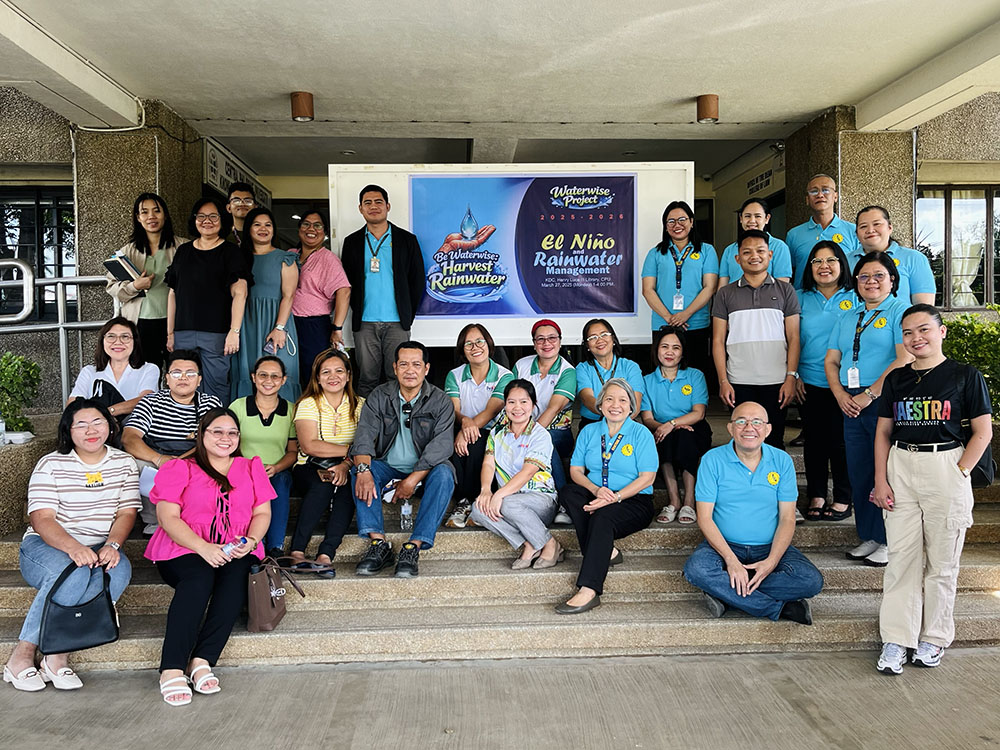
Speakers and participants gather at the Knowledge Development Center (KDC), Henry Luce III Library, to mark the successful launch of the Waterwise Seminar.
Marking the start of an initiative that makes every drop count, the United Board for Christian Higher Education in Asia, in partnership with Central Philippine University (CPU), recently held “Waterwise,” a seminar-workshop on El Niño and Rainwater Management. Held at the Knowledge Development Center, Henry Luce III Library last March 27, 2026, the event showcased the intersection of research, community-building, and public-private partnerships.
Dr. Aries Roda Romallosa, Acting Vice President for Research, Development, and Extension, commenced the event with a prayer, hoping how the importance of rainwater may be amplified through this initiative. Indeed, through the four keynote speakers, the community representatives coming from the project’s implementation sites, Brgy. San Isidro, Tabuc Suba, Bitoon, and Lanit, were able to gain a comprehensive grasp at the issue at hand.
Engr. Jeestin Kent Gabinera, a representative from the Iloilo City Environment and Resources Office (CENRO), detailed the current issues faced by the City, grappling through water scarcity, water quality, and climate change, and the current actions and proposals being enforced by the government to integrate blue-green development. Specifically, he emphasized the role of private institutions such as CPU in maintaining Iloilo’s status as “the Wakanda of the Philippines.”
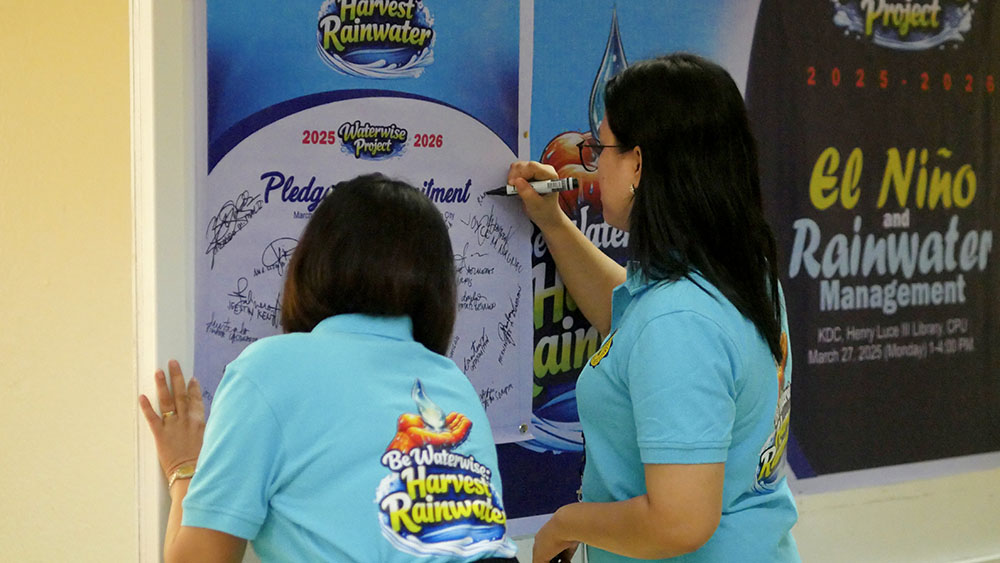
Community members formalize their dedication to local conservation by signing a pledge to protect and manage their shared water systems for future generations.
Following this, Dean Stella G. Fernandez, the Project Leader for the Waterwise Project and incumbent Dean of the College of Arts & Sciences, tackled how research played a part in creating sustainable and enforceable changes in the aforementioned baranggays. Their study found that the main issue is that rainwater collection was not institutionalized, and while their community respondents were aware of proper practices in theory, they were not implemented. As such policies needed to be put in place to safeguard the practice and make it climate-resilient. She pledged CPU’s assistance in conservation, education, and responsible action, promising to restore balance one drop at a time. She also lauded her fellow researchers Dr. Dimpna C. Castigador, Dr. Jelvit Amor C. Alicante, Novi B. Pascua, and Jazel May D. Juntoria in their dedication to seeing this project through.
Transforming abstract data into appealing and understandable visuals, Mr. Luel Sanchez, CPU TV Channel Coordinator, presented to the representatives different mediums they may use to better disseminate Waterwise’s results to their constituents. As per Mr. Sanchez, communication is the weapon they must use to implement their program by presenting water conservation in the language the people recognize.
Moving beyond communication and research, Atty. Rhona Eresuelo, Faculty of the College of Arts & Sciences, assisted each LGU in drafting a barangay-level resolution based on the findings of the study. Each barangay representative was empowered and guided in drafting their own policies.
No workshop is complete without feedback, and this is what transpired after all of the presentations. Barangays were given the opportunity to air out challenges and difficulties, while trying to implement the project in their locale. They were catered to by the different experts coming from both private and public sectors present at the event.
Culminating the fruitful afternoon, Waterwise Facebook page was launched, and to formally accept the challenge, all participants pledged to a covenant that would actively support the initiative through awareness and upholding a shared responsibility to make water safe and sustainable.
From grassroots communities to institutions, Waterwise is a reminder that when the academe reaches beyond its walls into communities, it can make a life-changing difference for the present and future generations to come.