By Mikee Natinga Norico
 Congratulations to Engr. Jebie Balagosa, Ph.D., for leading a groundbreaking study published in the Q1 journal Nuclear Engineering and Technology. We are incredibly proud of you!
Central Philippine University (CPU) once again celebrates a research milestone as Engr. Jebie Balagosa, Ph.D., a distinguished Geotechnical Engineer, DOST-PCIEERD Balik Scientist Awardee, and Associate Professor at the CPU College of Engineering, serves as lead author of a newly published open-access publication in the Q1 journal Nuclear Engineering and Technology (NET). This journal is a Q1, SCIE-indexed international journal of the Korean Nuclear Society that publishes peer-reviewed research across the full spectrum of nuclear science, engineering, safety, and radioactive waste management.
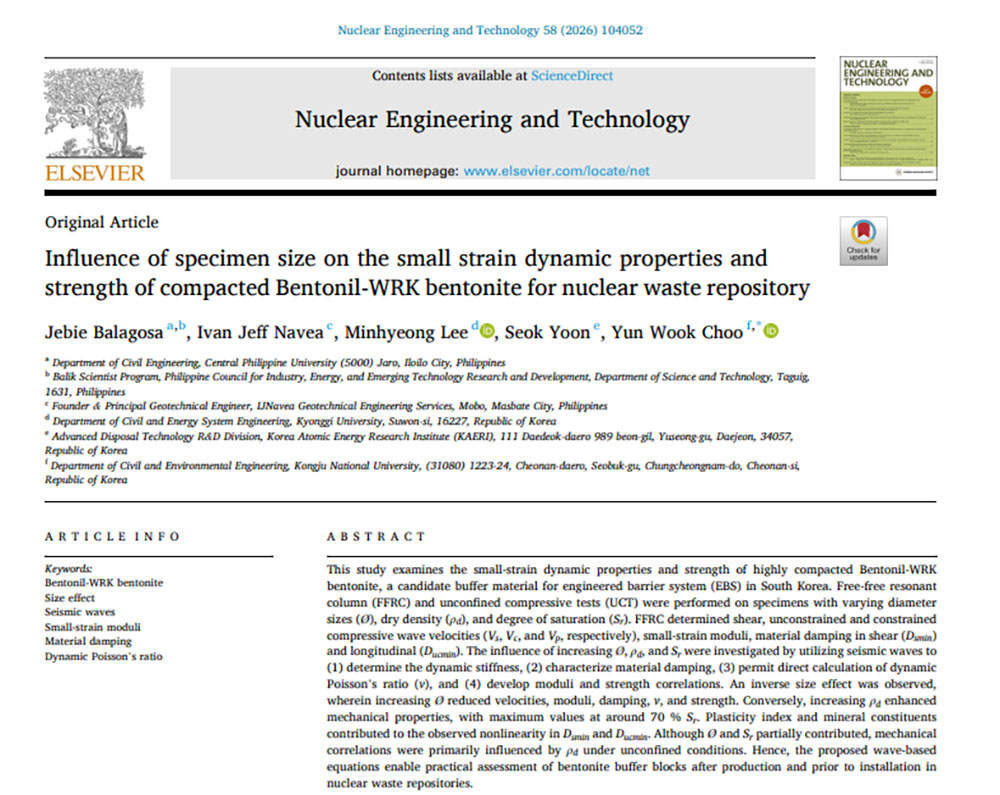
The study, titled “Influence of Specimen Size on the Small-Strain Dynamic Properties and Strength of Compacted Bentonil-WRK Bentonite for Nuclear Waste Repository”, investigates the mechanical behavior of highly compacted Bentonil-WRK bentonite—a potential buffer material for engineered barrier systems in South Korea’s nuclear waste management programs. Using free-free resonant column (FFRC) and unconfined compressive tests (UCT), the researchers examined the effects of specimen diameter, dry density, and saturation on dynamic properties, material damping, and strength, providing critical insights for practical applications in nuclear waste repositories.
This international collaboration was made possible through partnerships involving the Balik Scientist Program, Philippine Council for Industry, Energy, and Emerging Technology Research and Development (DOST-PCIEERD), IJNavea Geotechnical Engineering Services in Masbate, and several renowned institutions in South Korea, including Kyonggi University, Korea Atomic Energy Research Institute (KAERI), and Kongju National University.
The study revealed notable findings, including an inverse size effect where increasing specimen diameter reduced velocities, moduli, damping, and strength, while higher dry densities improved mechanical properties, particularly at around 70% saturation. The research also established practical wave-based equations for assessing bentonite buffer blocks prior to installation, contributing to safer and more efficient nuclear waste repository designs.
Dr. Balagosa’s involvement underscores CPU’s growing presence in advanced geotechnical and nuclear engineering research, highlighting the University’s commitment to fostering global collaborations and producing high-impact scholarly work.
This achievement brings pride to CPU and demonstrates the University’s continuous pursuit of excellence in research, innovation, and academic contribution to pressing scientific and technological challenges.
The research team gratefully acknowledges the generous support that made this work possible, with funding provided by the National Research Foundation of Korea (NRF) through the Korea government (MSIT) under Grant Nos. RS-2021-NR059360, RS-2024-00406320, and RS-2025-24536383. Lead author Dr. Jebie Balagosa also extends his gratitude to the Balik Scientist Program of the Department of Science and Technology (DOST), Philippines, through the Philippine Council for Industry, Energy and Emerging Technology Research and Development (PCIEERD), as well as to the 2025 Philippines–Korea Joint S&T Research Program supported by the DOST Grant-in-Aid (GIA) funding (No. 1214560). Sincere appreciation is likewise expressed to Central Philippine University for hosting Dr. Balagosa during his Balik Scientist engagement.
Congratulations to Dr. Balagosa and the research team for this remarkable accomplishment!
Read the full publication here: https://doi.org/10.1016/j.net.2025.104052