
By Vanessa Therese Ledesma, BACOMM-4, The Centralian Link Intern
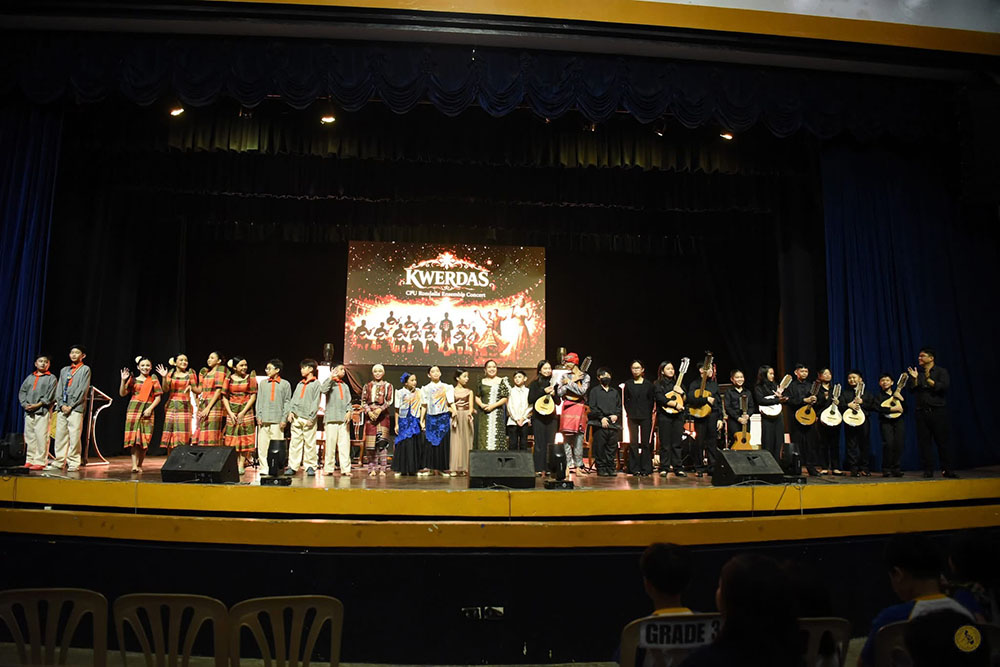
CPUES performers gather on stage for KWERDAS: CPU Rondalla Ensemble Concert held at the Rose Memorial Auditorium on March 11, 2026.
The Central Philippine University Elementary School (CPUES) highlighted the musical excellence and artistic talents of its learners during KWERDAS: CPU Rondalla Ensemble Concert held on March 11, 2026, at the Rose Memorial Auditorium (RMA).
The concert featured impressive performances from CPU elementary students who demonstrated discipline, dedication, and musical skill through the traditional string instruments of the rondalla ensemble under the direction of Dr. Rodrigo Sotto Jr. The event celebrated not only music but also the creativity and excellence of young Centralian performers.
The program opened with the Doxology led by the CPUES Tambourine Dancers, followed by the opening prayer delivered by Associate Minister of Campus Ministry, Pastor Justine Palmes-Mije. In her prayer, she thanked God for the gift of music and the talents entrusted to the learners while asking for confidence, harmony, and joy as they performed.
The Philippine National Anthem was then performed by Kenji Kenshin A. Ventura, a Grade 5-Excel learner.
In his greetings, Central Philippine University President Rev. Dr. Ernest Howard B. Dagohoy welcomed faculty members, parents, alumni, and students who gathered to support the young performers. He also recognized Dr. Florence P. Bogacia, Vice President for Finance and Enterprises, for her role in training the tambourine dancers.
Rev. Dr. Dagohoy shared the importance of reviving the rondalla tradition in the elementary department, recalling that years ago he and CPUES Principal Assoc. Prof. Janet P. Jaco discussed the full-scale revival of the ensemble.
He emphasized that the rondalla, composed of instruments such as the bandurria, laud, octavina, guitar, and bass, is an important part of Philippine cultural heritage. Originating from medieval Spain and later adapted into Filipino culture in the 15th century, the rondalla continues to evoke nostalgia, tradition, and pride while connecting generations through music.
In her words of welcome, Assoc. Prof. Janet P. Jaco reflected on the history of the CPUES Rondalla Ensemble, noting that the group existed years ago and included notable members such as CPU First Lady Dr. Cecile Gonzales-Dagohoy, who was once part of the ensemble.
She shared that the revival of the rondalla began in School Year 2018–2019 through a shared vision between her and Dr. Rodrigo Sotto Jr., which later gained the support of former university president Dr. Teodoro C. Robles.
Assoc. Prof. also expressed gratitude to the late Dr. Carmen Pama-Santos, whose generosity funded the purchase of 15 rondalla instruments in October 2018, making the revival possible. She also thanked Rev. Dr. Dagohoy for his continued support of music and the arts within the university.
The event rationale was presented by Mrs. Rouella Cheyenne C. Aberia, who highlighted that the rondalla ensemble was created to nurture the hidden musical talents of learners and to provide them with a platform to develop their artistic potential.
“The birth of the CPU Rondalla Ensemble was made possible by the late Carmen Pama-Santos, who envisioned a musical group that would unlock the learners’ hidden talents through the magical strings,” Aberia said.
The concert featured a diverse repertoire that showcased both international and Filipino musical excellence. Performances included “Spain” by Chick Corea, “Libertango” by Astor Piazzolla, and “Spring” from The Four Seasons by Antonio Vivaldi.
Traditional Filipino dances accompanied several musical pieces, including Tinikling, Itik-Itik, and Lapay Bantigue, a folk dance from Masbate.
The program also highlighted Filipino compositions such as “Kay Ganda ng Musika” and “Da Coconut Nut” by Ryan Cayabyab, “Bituing Marikit” by Nicanor Abelardo, and “Anak” by Freddie Aguilar.
Other performances included a BINI Medley, Pansak si Laley and Pansak si Bangku, and Aros de Flor, a traditional dance from Janiuay that reflects Spanish influence in Philippine culture.
One of the highlights of the program was “Gabi,” composed by Christi-Anne Salazar Castro, a rondalla-inspired piece influenced by Filipino folklore and the mysterious imagery of the aswang.
The concert concluded with “Bagong Paso Doble” composed by Juan Silos Jr., serving as the finale.
Through their confident performances and musical discipline, the CPUES learners demonstrated that excellence in the arts can be nurtured even at a young age. The concert served as a testament to the dedication, training, and passion of the students who continue to bring pride to the Centralian community.
As emphasized during the event, music is more than sound: it is memory, culture, and identity.