By Mikee Natinga Norico
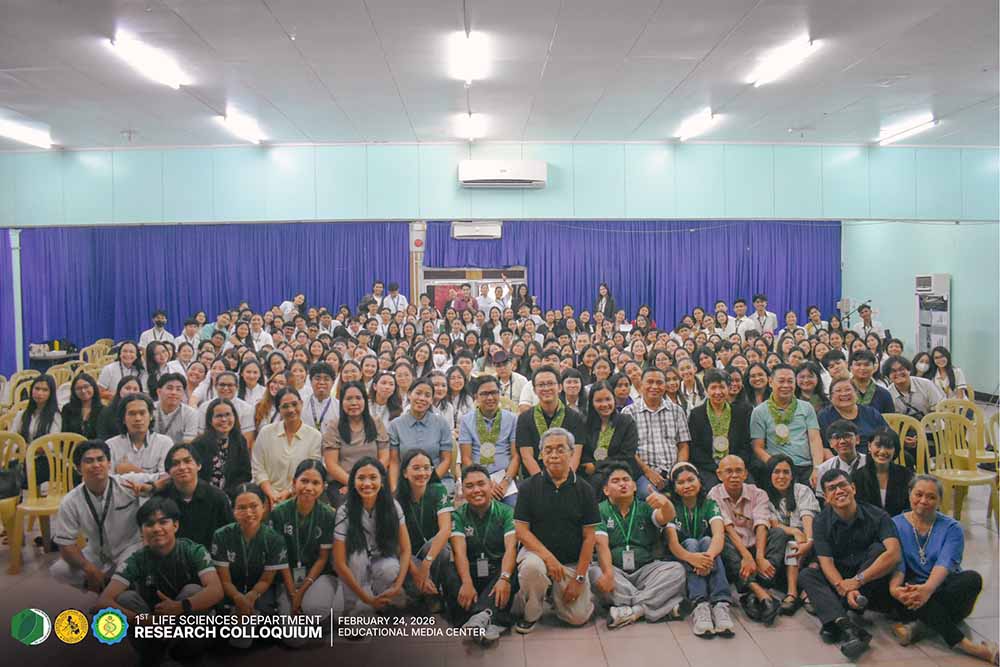
Faculty members, students, and guest speakers pose for a group photo following the successful 1st Life Sciences Department Research Colloquium at the Conference Room of the Educational Media Center (EMC).
On February 24, 2026, the 1st Life Sciences Department Research Colloquium, themed “Diving into the Potential of the Natural Sciences,” was successfully held at the Educational Media Center Conference Room. The event was organized by the Life Sciences Department in collaboration with the CPU Biological Society.
More than just a platform for presenting studies, the colloquium celebrated inquiry, perseverance, and the emerging scholarship of the fourth-year students. The event brought together faculty members, students, and invited experts in an academic atmosphere marked by critical thinking and a meaningful exchange of ideas.
In her welcome remarks, Dr. Stella Guartero-Fernandez, Dean of the College of Arts and Sciences, emphasized the importance of cultivating a strong research culture among students in higher education. She commended the young researchers for their commitment to scientific exploration and encouraged them to continue pursuing studies that contribute to community development and innovation in the future.
The colloquium featured two plenary lectures by distinguished experts in their respective fields. Dr. Sanny David Lumayno of the University of the Philippines Visayas delivered a lecture on “Advancing Sustainable Aquaculture: Marker-Assisted YY Male Technology in Saline-Tolerant UPV SpiN Tilapia Hybrid.” His discussion highlighted innovative genetic approaches aimed at improving aquaculture productivity and sustainability, particularly in saline environments.
Meanwhile, Mr. Philip Cruz, President of Herbanext Laboratories, Inc., shared insights on “Applications of Natural Product Extracts in Health and Wellness.” His lecture emphasized the growing role of plant-based compounds in developing health supplements and therapeutic products, bridging the gap between academic research and industry applications.
A highlight of the event was the oral and poster research presentations by fourth-year students, whose studies showcased a wide range of interests in the natural sciences—from biomedical research to innovations in renewable energy.
Clinching first place in the oral presentation category were Jaeniefehr Lhouise Murugathas, Milan Antonette Soloren, Andreanna Faith Tambong, and Mica Charl Villanueva for their study titled “Neem (Azadirachta indica) Leaf Extract as a Promising Therapeutic Agent for Wound Healing in Streptozotocin-Induced Diabetic White (Mus musculus).” Their research explored the therapeutic potential of neem leaf extract in enhancing wound healing in diabetic models.
Second place was awarded to Roxanne Mae Amparado, Dhina Grace Andre-i, and Shyne Angelie Nobleza for their study, “In Silico Study of Phytochemicals Extracted from Chromolaena odorata (Linnaeus) (King and Robinson) Against Acinetobacter baumannii,” which investigated plant-derived compounds as potential antibacterial agents.
Placing third were Sean Rafael Puda, Jyrrianne Masangkay, Christine Joy Cabrera, and Karen Joy Tumaob for their innovative study, “Dye-Sensitized Solar Cells Using Red Dragon Fruit (Selenicereus costaricensis) Peel Pigment Extract as Base Dye,” showcasing the potential of natural pigments in renewable energy technologies.
The Best Poster Presentation award was conferred upon Stephanie Kaye Maca, Farah Mae Carbonel, Yara Khaled Mohammed, and Ma. Danisa Carmelita for their outstanding visual and research presentation.
In her closing remarks, Asst. Prof. Cherrylyn Macairan, Chairperson of the Life Sciences Department, expressed gratitude to the speakers, faculty members, and students for contributing to the success of the department’s inaugural research colloquium. She emphasized that the event marked a significant step in strengthening CPU’s research engagement in the natural sciences.
Through its 1st Research Colloquium, the Life Sciences Department reaffirmed its commitment to fostering scientific inquiry and empowering students to push the boundaries of knowledge—diving deeper into the vast potential of the natural sciences.