By Mikee Natinga Norico
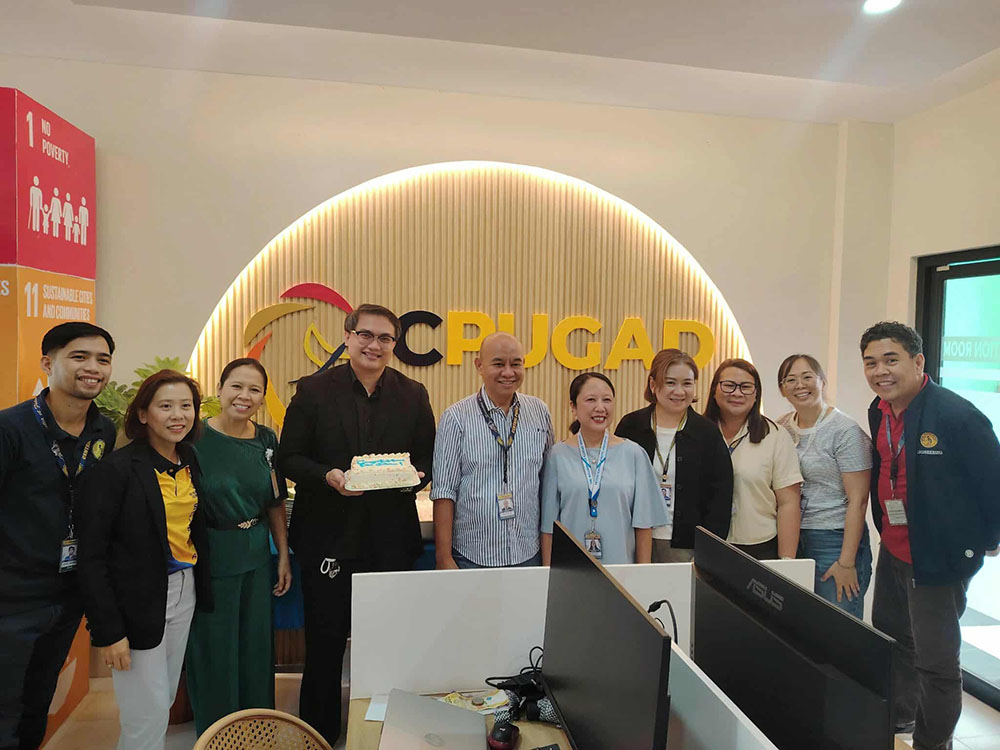
Engr. Jebie A. Balagosa, Ph.D., DOST–PCIEERD Balik Scientist Awardee, poses for a celebratory group photo with CPU administrators, faculty, and staff following his successful exit report presentation.
Central Philippine University (CPU), in partnership with the Department of Science and Technology (DOST) Balik Scientist Program, held the Exit Report Presentation of Engr. Jebie A. Balagosa, Ph.D., a distinguished Geotechnical Engineer, DOST–PCIEERD Balik Scientist Awardee, and Associate Professor at the CPU College of Engineering, on December 5, 2025, via Zoom. The online gathering brought together university officials, faculty members, students, research partners, and representatives from DOST to highlight the milestones achieved during Dr. Balagosa’s six-month engagement with CPU.
The program opened with a prayer led by Dr. Florence P. Bogacia, Vice President for Finance and Enterprises, setting a reflective tone for the meaningful presentations and testimonies that followed.
In his opening remarks, Rev. Dr. Ernest Howard B. Dagohoy, University President, welcomed participants to the significant event recognizing Dr. Balagosa’s work under the DOST Balik Scientist Program. He expressed gratitude to DOST and its leaders for their continuous support and acknowledged the contributions of Dr. Balagosa’s colleagues and family. Rev. Dr. Dagohoy emphasized the importance of Dr. Balagosa’s research in geotechnical engineering—particularly its role in promoting sustainable, cost-effective construction practices and regional development. He highlighted how the project aligns with CPU’s mission of serving communities through science and innovation. He extended his congratulations, thanked God for the scientist’s achievements, and ended his message with a passage from Romans 11:33–36.
Dr. Enrico C. Paringit, Executive Director of DOST–PCIEERD, delivered a welcome message recognizing CPU’s historic milestone as a first-time host institution for a Balik Scientist. He noted that the engagement demonstrates CPU’s emerging leadership in advancing science and technology in Western Visayas. He also commended Dr. Balagosa for strengthening CPU’s research capacity by training young engineers, developing new research proposals, and cultivating partnerships with universities and research centers such as UP Visayas, the Regional Research Center, and Kongju National University in South Korea. Dr. Paringit highlighted the broader impact of the Balik Scientist Program, which since 2013 has engaged 181 scientists across 91 institutions—affirming that investing in people builds stronger research ecosystems. He concluded by noting that Dr. Balagosa’s work has left a meaningful imprint on CPU and contributes to national scientific progress.
In his report titled “From Waste to Worth: Can Sustainable Geotechnics Empower Our Regions?”, Dr. Balagosa presented the results of his six-month engagement under the Balik Scientist Program. His work explores how agricultural and industrial by-products can be transformed into materials that strengthen soil, improve construction quality, and create new economic opportunities.
At this point in his presentation, Dr. Balagosa also reflected on his personal path to becoming a scientist, emphasizing that it was not defined by perfect grades or a flawless academic record, but by hard work, consistency, and learning from real-world experience. He shared how his early research and professional work taught him the importance of safety in waste management and revealed how waste materials can be engineered into valuable resources—ideas that later shaped his passion for sustainable geotechnics. He further spoke about how his leadership philosophy was molded during his term as the youngest Philippine Institute of Civil Engineers (PICE)–South Korea President, where serving Filipino engineers abroad strengthened his commitment to service, collaboration, and empowering others. These experiences, he shared, formed the foundation of his mission as a Balik Scientist for CPU and Western Visayas.
He then outlined the extensive outputs achieved during the program. One of his key accomplishments was the bilateral MOU/MOA between CPU and the UP Visayas Regional Research Center (RRC) and Materials Science and Nanotechnology (MSN) Laboratory, securing CPU’s access to advanced SEM–EDS microstructural testing essential for understanding soil–by-product interactions. Parallel to this, he strengthened an international partnership with Kongju National University (KNU), where he and his graduate studies adviser, Prof. Yun Wook Choo, served as co-proponents for Project GEO-DYNAMIX, reflecting CPU’s rising presence in international collaborative research.
Dr. Balagosa also led significant improvements in CPU’s research infrastructure. With the initial funding provided by the CPU Board of Trustees, he coordinated and guided undergraduate students in the design and fabrication of experimental apparatus, designed testing layouts, and supported the acquisition of essential experimental equipment. The same funding allowed CPU to subsidize microstructural experiments conducted at the UPV RRC–MSN Lab. These developments now form the backbone of CPU’s emerging geotechnical testing facility.
He conducted extensive field and laboratory investigations, securing agricultural by-products through the support of INA Farm and the Dolorfino Rice Mill management and collecting over 600 kg of soil through DPWH Region VI. These materials were used to generate foundational datasets for future mix-design optimization in sustainable geotechnics.
In research productivity, Dr. Balagosa published a Q1 paper in Nuclear Engineering and Technology as lead author, co-wrote manuscripts with CPU faculty, and presented outputs in multiple national and international conferences. His article in the International Press-in Association Newsletter featured innovations in sustainable ground improvement using wood pellet fly ash.
One of the most significant achievements presented was the approval of Project GEO-DYNAMIX, a three-year international collaboration between CPU and Kongju National University funded under the 2025 Philippines–Korea Joint S&T Research Program (DOST GIA). Dr. Balagosa also co-developed the parallel proposal and testing plan submitted by Prof. Choo to the National Research Foundation of Korea, securing a combined international funding of approximately PHP 10 million for waste-based binder development and advanced dynamic testing. Together, these projects establish CPU as a long-term research leader in sustainable geotechnics.
Throughout his engagement, Dr. Balagosa prioritized capacity-building by mentoring undergraduate and graduate researchers, guiding thesis work from conceptualization to experimental planning, and serving as a panelist in Civil Engineering thesis defenses. His training sessions, reviews, and technical guidance strengthened CPU’s culture of research and innovation. He also elevated CPU’s visibility by representing the university in key national and regional scientific platforms, including the DA–PRDP seminar-workshop, RRDIC meetings, the WVCIEERD–Jeju National University symposium, PICE South Korea’s CE Career Pathways forum, the Recoletos Graduate Research Conference, and various DOST Science, Technology, and Innovation Week events.
During the open forum, participants engaged Dr. Balagosa with questions on sustainable geotechnics, waste utilization, and future research directions.
This was followed by reflections from individuals who worked closely with him, including CPU Civil Engineering students; Engr. Shevanee Ruth Dela Cruz, Chair of the Civil Engineering Department; and Engr. Mary Earl Daryle Grio, Dean of the CPU College of Engineering. They shared how the Balik Scientist Program expanded their perspectives on research, innovation, and the environmental impact of engineering practices.
In her closing remarks, Dr. Aries Roda D. Romallosa, Acting Vice President for Research, Development, and Extension, reflected on the event as the culmination of a journey driven by expertise, purpose, and collaboration. She highlighted how Dr. Balagosa’s engagement introduced advanced knowledge, sparked scientific curiosity, and strengthened a culture of rigor and innovation among CPU’s faculty and students.
Dr. Romallosa noted that the discussions on waste utilization reshaped the university’s understanding of how ordinary agricultural by-products can be transformed into valuable geotechnical materials. She emphasized that these collaborative efforts helped secure the newly approved USDP-funded international project GEO-DYNAMIX, further positioning CPU as a regional leader in sustainable geotechnics and disaster risk management. She expressed deep gratitude to DOST, DA, DPWH, academic partners, and CPU’s faculty, researchers, students, and staff—especially the RDE team—for supporting the program and believing in Filipino scientific talent.
The event concluded with a sense of accomplishment and anticipation, marking not only the completion of Dr. Balagosa’s Balik Scientist engagement but also the beginning of new scientific endeavors that aim to empower communities through sustainable, innovative geotechnical solutions. A full recording of the Exit Report Presentation is available for viewing through this Facebook link: https://www.facebook.com/share/v/1CCfMjfHoa/.