By Atasha Gabrielle P. Vito, BA ELS 4, Centralian Link Intern
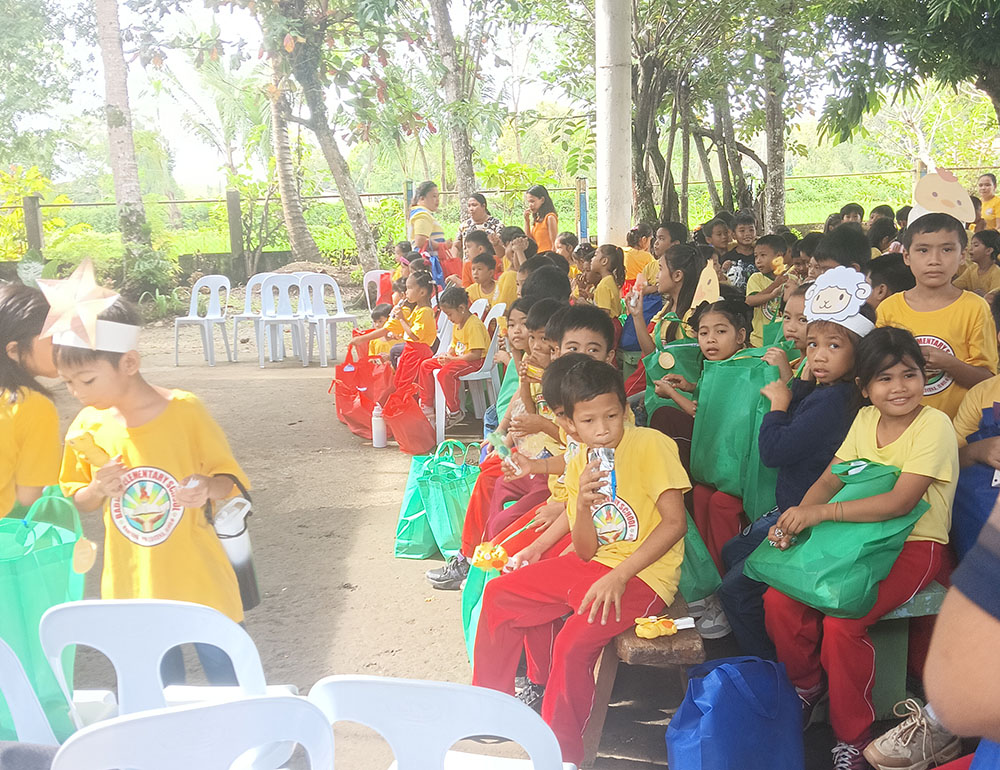
The learners of Badiang Elementary School (right) in their seats after the gift-giving portion of the outreach with the parents and faculty of the school during the Project L.E.A.P.: Lighting Every Aspiring Page.
On December 5, 2025, the Central Philippine University (CPU) College of Arts and Sciences, through the Department of Languages, Mass Communication and Humanities (DLMCH), conducted an outreach activity titled Project L.E.A.P.: Lighting Every Aspiring Page at Badiang Elementary School in New Lucena, Iloilo.
The project aimed to enhance the vocabulary and literacy skills of learners from Grades 1 to 6 while providing members of the English Language Society–CPU (ELS) and the CPU Communication Circle (CCC) with hands-on experience in the primary education setting.
The outreach featured the distribution of books, toys, and school supplies to the pupils of Badiang Elementary School. DLMCH student volunteers from ELS and CCC actively engaged the children through interactive lessons focused on vocabulary and spelling. Games and activities, including storytelling, were conducted to ensure an enjoyable and meaningful learning experience for all participants. Learners from Grades 4 to 6 participated in guided reading discussions, while younger pupils were engaged through storytelling sessions and spelling quizzes.
Student volunteers from DLMCH prepared their own teaching materials, prizes, and giveaways for the pupils. They also shared stories and led songs to further capture the children’s interest and participation. Through the activity, the volunteers applied concepts learned in their classes by utilizing effective teaching strategies, creating instructional materials, and fostering learner engagement.
Parents of the elementary school pupils prepared meals and refreshments for the volunteers and teachers present during the outreach, warmly welcoming the DLMCH community into their school. The pupils likewise expressed enthusiasm and excitement as they actively participated in the lessons and activities facilitated by the volunteers.
The activity proved to be a valuable teaching and learning experience for DLMCH students, allowing them to explore creative and learner-centered approaches to instruction. It emphasized the importance of adaptive teaching methods that foster meaningful connections between educators and learners. Through literacy, language, and vocabulary development, Project L.E.A.P. sought to bridge learning gaps and strengthen collaboration between the two institutions.
The Department of Languages, Mass Communication and Humanities extends its gratitude to the volunteers, partner teachers, and most especially to the learners who made the outreach meaningful and successful.