By Asst. Prof. Sarex Dalida Dipol, Jr.
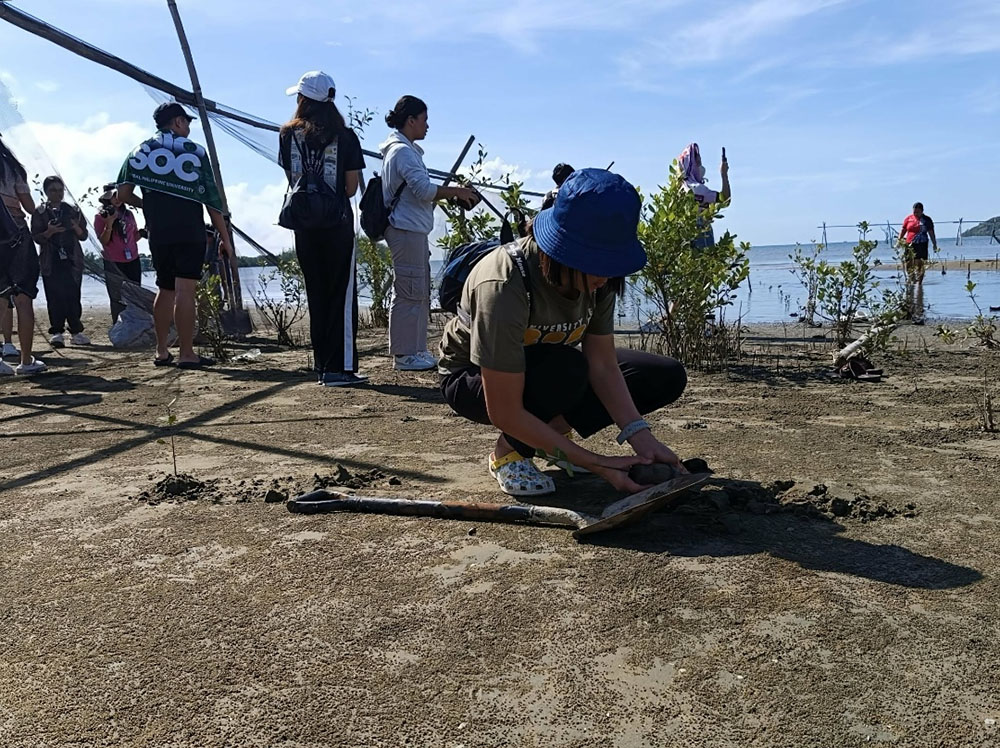
Asst.Prof. Kareen Jay D. Lozada (Green), Chairperson of the Department of Social Work, together with selected faculty members and students, participated in the mangrove-growing activity at Station 3 of the Center for Mangroves and Marine Biodiversity Conservation in Barangay Culasi, Ajuy, Iloilo.
On December 15, 2025 (Monday), the College of Arts and Sciences organized a mangrove-growing activity at Station 3 of the Center for Mangroves and Marine Biodiversity Conservation, located in one of the University’s adopted barangays, Barangay Culasi, Ajuy, Iloilo. This environmental rehabilitation initiative is part of the College’s centennial (100th year) celebration.
Before the activity, Dr. Stella Guartero-Fernandez, a biologist and College Dean, discussed proper mangrove planting techniques, the characteristics of the coastal area, and the different mangrove species found at the site. Meanwhile, the Director of the Community Engagement and Service-Learning Center (CESLC) encouraged the selected faculty members and students to use the mangrove sites for instruction, research, development, and extension.
Aside from faculty members and students, selected barangay officials and Sangguniang Kabataan (SK) representatives also participated in the environmental rehabilitation initiative. Several student organizations, including the CPU Biological Society, the Junior Social Workers Association of the Philippines (JSWAP)–CPU Chapter, and the Central Philippine University Outreach Student Volunteers Society, identified potential outreach activities in the area, particularly in waste management and in addressing the barnacle infestation affecting young mangroves.
A total of 100 mangrove seedlings were planted during the activity. Beyond environmental rehabilitation, the initiative aims to promote food and nutrition security and strengthen biodiversity conservation in the area.