By Mikee Natinga Norico
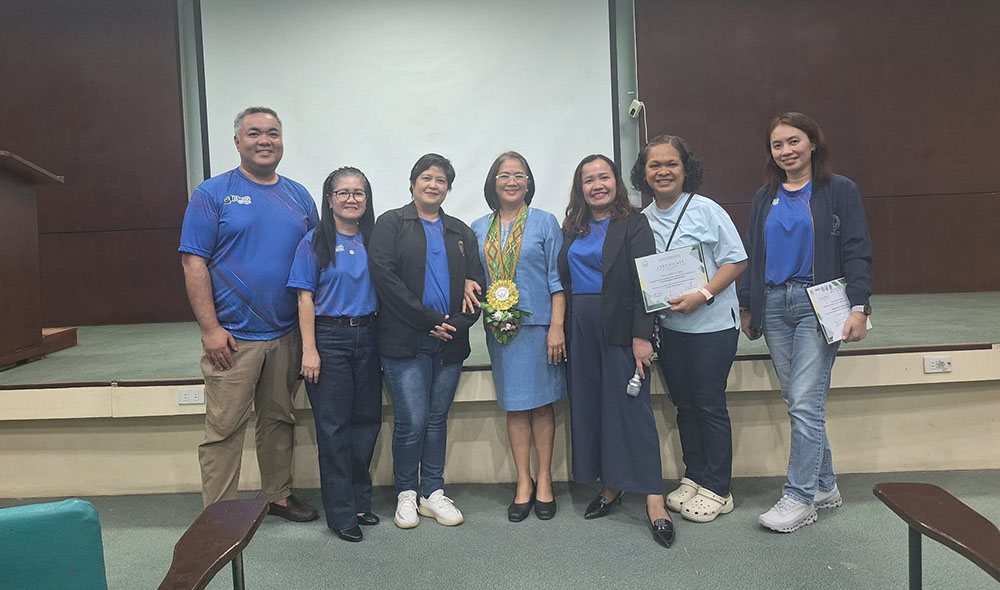
Dr. Stella G. Fernandez (center), Dean of the College of Arts and Sciences, poses with NDDU administrators following the successful seminar on AI in education.
On March 12, 2026, Central Philippine University (CPU) College of Arts and Sciences Dean Dr. Stella G. Fernandez served as a resource speaker during a faculty development seminar on the use of artificial intelligence (AI) in higher education classrooms at Notre Dame of Dadiangas University (NDDU).
The seminar, titled “Use of Artificial Intelligence (AI) in Higher Education Classrooms,” gathered NDDU college faculty members and aimed to equip educators with the knowledge, skills, and ethical awareness necessary to effectively integrate AI technologies into classroom instruction. The initiative also sought to enhance teaching and learning practices, promote academic integrity, and support innovative, human-centered pedagogy through practical applications.
Anchored on the Commission on Higher Education’s (CHED) RAISE and HUSAY projects, the seminar-workshop aligned with national initiatives to strengthen higher education. CHED RAISE is a CHED-led program that promotes the responsible and strategic use of artificial intelligence in higher education for societal empowerment, while CHED HUSAY supports the upskilling and further academic development of higher education staff and faculty to improve institutional quality and performance.
As the resource speaker, Dr. Fernandez led discussions introducing fundamental AI concepts and their applications in higher education. She also guided participants through the practical use of AI-powered tools for lesson planning, student engagement, and assessment, emphasizing the importance of responsible and ethical implementation in academic settings.
The seminar-workshop featured a combination of lectures, discussions, and hands-on activities designed to provide participants with both theoretical understanding and practical experience. Faculty members engaged in exercises that enabled them to identify and demonstrate AI tools relevant to their teaching practices and develop AI-enhanced lesson plans aligned with their course outcomes.
In addition, the seminar highlighted key issues related to academic integrity, ethics, and data privacy in the use of AI. Participants were encouraged to formulate classroom guidelines that promote responsible AI use while maintaining the quality and integrity of education.
By the end of the workshop, participants were able to articulate core AI concepts, apply AI tools in instructional design, and develop actionable strategies for integrating AI into their courses. They also crafted personal or course-level action plans outlining concrete steps for adopting AI in their teaching within the current or upcoming academic term.
The seminar underscored the growing importance of AI in education and reaffirmed the role of educators in ensuring that technological advancements are utilized to support meaningful, ethical, and student-centered learning experiences.