
By Mikee Natinga Norico
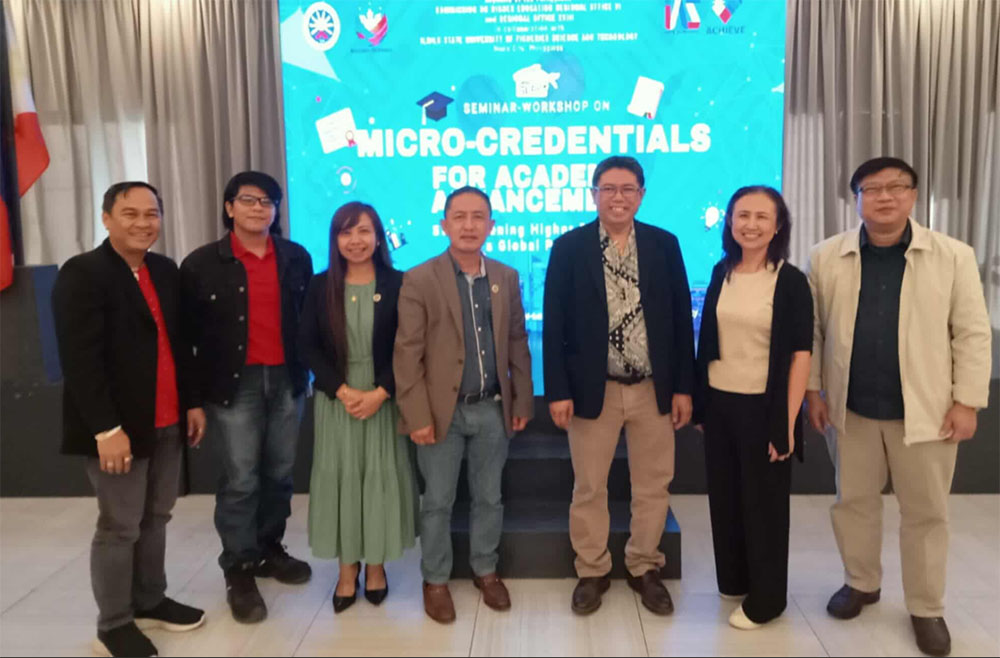
(L–R) CHEDRO-VI Chief Education Program Specialist Dr. Danebeth G. Narzoles (3rd from left), representatives from Silliman University, CHED-Region XVIII–NIR Regional Director Dr. Raul C. Alvarez, Jr. (center), and CPU-CTLE Director Dr. Ananias C. Sabijon, Jr. (1st from right) pose for a photo opportunity during the seminar-workshop titled “Micro-Credentials for Academic Advancement: Strengthening Higher Education with a Global Perspective,” held on December 12–13, 2025, at Northwest Inn, Bacolod City.
Central Philippine University (CPU), in line with its commitment to provide Exemplary Christian Education for Life (EXCEL), actively participated in the seminar-workshop titled “Micro-Credentials for Academic Advancement: Strengthening Higher Education with a Global Perspective” held on December 12–13, 2025, at Northwest Inn, Bacolod City.
Based on the memorandum issued by CHED Region VI Director Dr. Raul F. Muyong, the activity was conducted in accordance with CHED Memorandum Order (CMO) No. 1, series of 2025, titled “Guidelines for Micro-Credential Development, Approval, and Recognition in Higher Education.” The seminar-workshop also formed part of the continuing celebration of ASEAN Month with the theme “Inclusivity and Sustainability.” It was organized and facilitated by the Commission on Higher Education (CHED) Regional Office VI (CHEDRO VI) and CHEDRO XVIII – Negros Island Region (NIR), in collaboration with the Iloilo State University of Fisheries, Science and Technology (ISUFST).
The seminar-workshop aimed to: (1) Deepen understanding of micro-credentials as innovative tools for enhancing academic advancement and lifelong learning in higher education; (2) Examine international models and best practices in the design, implementation, and recognition of micro-credentials; (3) Explore strategies for integrating micro-credentials into institutional policies, curricula, and quality assurance frameworks within a global context; and (4) Foster collaboration among Higher Education Institutions (HEIs) and stakeholders in developing micro-credential programs that promote academic mobility, employability, and internationalization.
The participants (included VPAA, IRO, Director, Dean) came from selected Higher Education Institutions (HEIs) in CHED Region VI (Western Visayas) and CHED Region XVIII – Negros Island Region (NIR).
Dr. Ananias C. Sabijon, Jr., (PhD in Education, major in Curriculum Development), Director of the Central Philippine University (CPU) Center for Teaching and Learning Excellence (CTLE) and Program Head of the Doctor of Education (major in Curriculum and Instruction), CPU School of Graduate Studies, represented the University during the event.
The two-day seminar-workshop commenced with an opening prayer and welcome messages, followed by a presentation by Dr. Greg T. Pawilen, CHED Micro-Credential Technical Evaluator. Facilitators and speakers from ISUFST also shared their institutional journey in developing policies, guidelines, and implementation processes for micro-credential programs in accordance with CMO No. 1, series of 2025.
Participants subsequently presented their respective HEIs’ established and proposed micro-credential programs and outputs developed during the workshop proper.
In his presentation, Dr. Sabijon emphasized that, in alignment with CHED’s policy on micro-credentials, Central Philippine University has collaborated with Silliman University (SU) in the development of a research paper on micro-credentials authored by Dr. Dave E. Marcial (SU), Dr. Ananias C. Sabijon, Jr. (CPU), and Dr. Elve O. Nasvik (SU). He also shared that the CPU Center for Teaching and Learning Excellence has initiated the development of modules on teaching effectiveness anchored on recognized educational standards. These modules are designed for faculty members seeking to strengthen their pedagogical competencies and will be made available to CPU faculty members as well as to other educators interested in collaborating with the Center.
Dr. Sabijon expressed his gratitude to CPU President Rev. Dr. Ernest Howard B. Dagohoy for his strong and continuing support of the programs and initiatives of the CPU-CTLE.